
Transformation and Performance · M&A, Partnerships and Market Entry
If this is on your desk right now, EDON offers a free 30-minute sparring session, with no obligation.
Book 30 minutes (opens in a new tab)
For CEOs and CFOs setting the 2027 budget, the right sum for generative AI is the full cost of the use cases that meet three conditions: a named owner, a baseline and a target, and money to change the work as well as buy the tool. Release it in stages, and use outside benchmarks only to check the total.
Most boards will be asked for more in this budget round. In Gartner's 2027 CEO Survey (opens in a new tab), published on 20 October, 75% of CEOs and senior executives planned to increase technology investment, while 44% of CEOs said they struggle to demonstrate financial returns from AI to stakeholders. In BCG's AI Radar 2026 (opens in a new tab), 94% of CEOs said they would keep investing in AI at current or higher levels even if the investment did not pay off in the next year. Across four surveys published in 2026, 75% to 94% of leaders say they will hold or raise their spending, while 6% to 37% report a return, depending on how strictly it is measured (Exhibit 1).
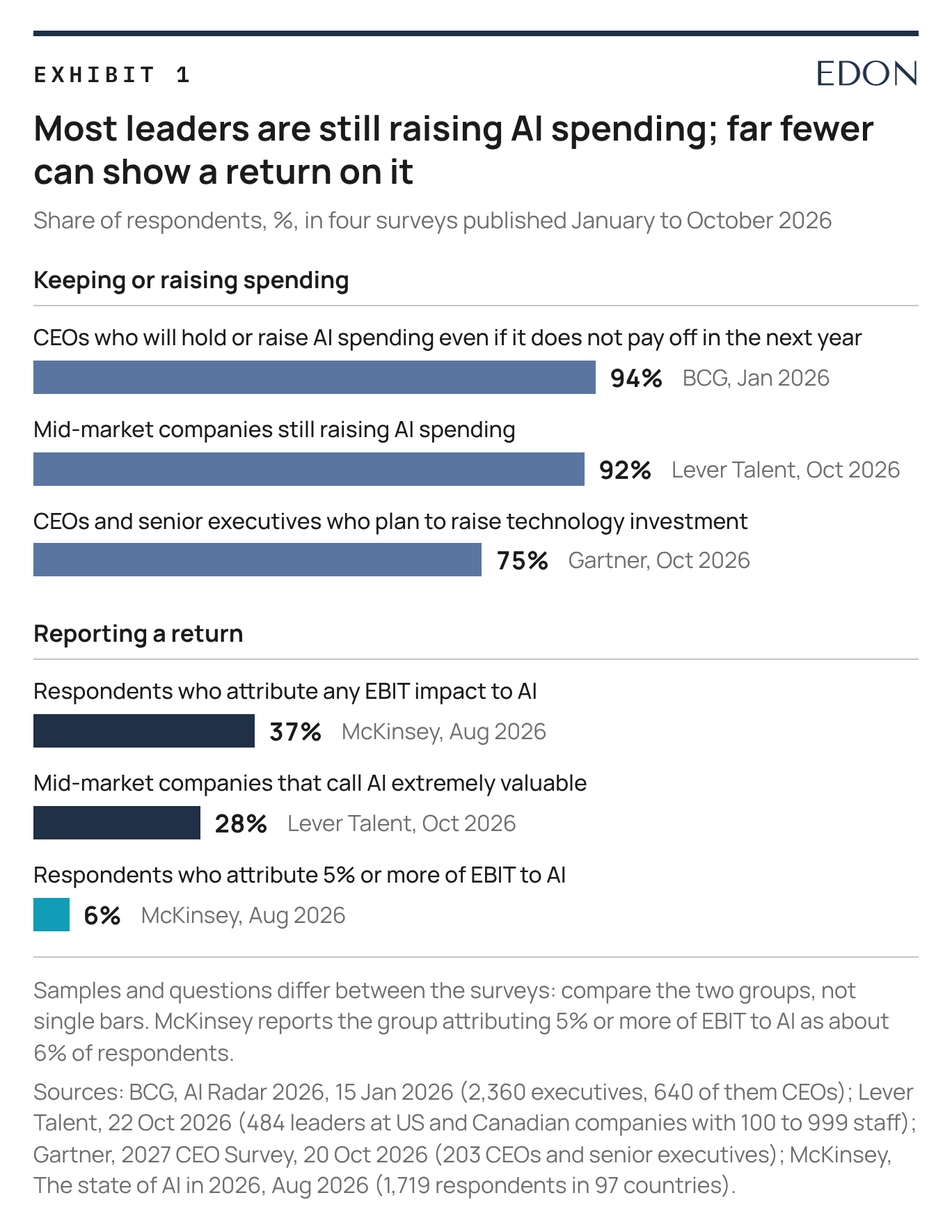
Exhibit 1. Most leaders are still raising AI spending; far fewer can show a return on it.
Finnish companies are ahead of the European average. Statistics Finland (opens in a new tab) found that 38% of enterprises used AI technologies in spring 2025, up 14 percentage points in a year, and 68% of those with at least 100 employees. In the European Investment Bank's 2025 survey (opens in a new tab), 66% of Finnish firms used generative AI, against 37% across the EU. For a Finnish company of 100 staff or more, using AI is already the norm; the 2027 question is what the money is tied to.
Build the figure from the use cases, and use a share of revenue only as a check. BCG's AI Radar 2026, a survey of 2,360 executives in 16 markets, found companies planning to double their AI spending in 2026, to about 1.7% of revenue on average: 2.1% in technology companies, 2.0% in financial institutions and 0.8% in industrial companies and real estate (Exhibit 2). McKinsey's State of AI 2026 (opens in a new tab) gives a second reference point: its high performers, the respondents who attribute 5% or more of their organisation's EBIT to AI, are more than twice as likely as others to spend over 15% of their ICT budget on AI.
The BCG figure records what companies plan to spend at a time when most cannot yet show a return, so matching it copies their habits along with the number. McKinsey's high performers may spend more because their AI already pays. List each use case the company means to fund in 2027 and cost it in full: licences, integration, data work, process redesign, training and running costs. Fund the lines that meet the conditions below, then compare the total with the benchmark. A total well above it needs a reason. If the total is well below it, look for what was left out, starting with training and process redesign.
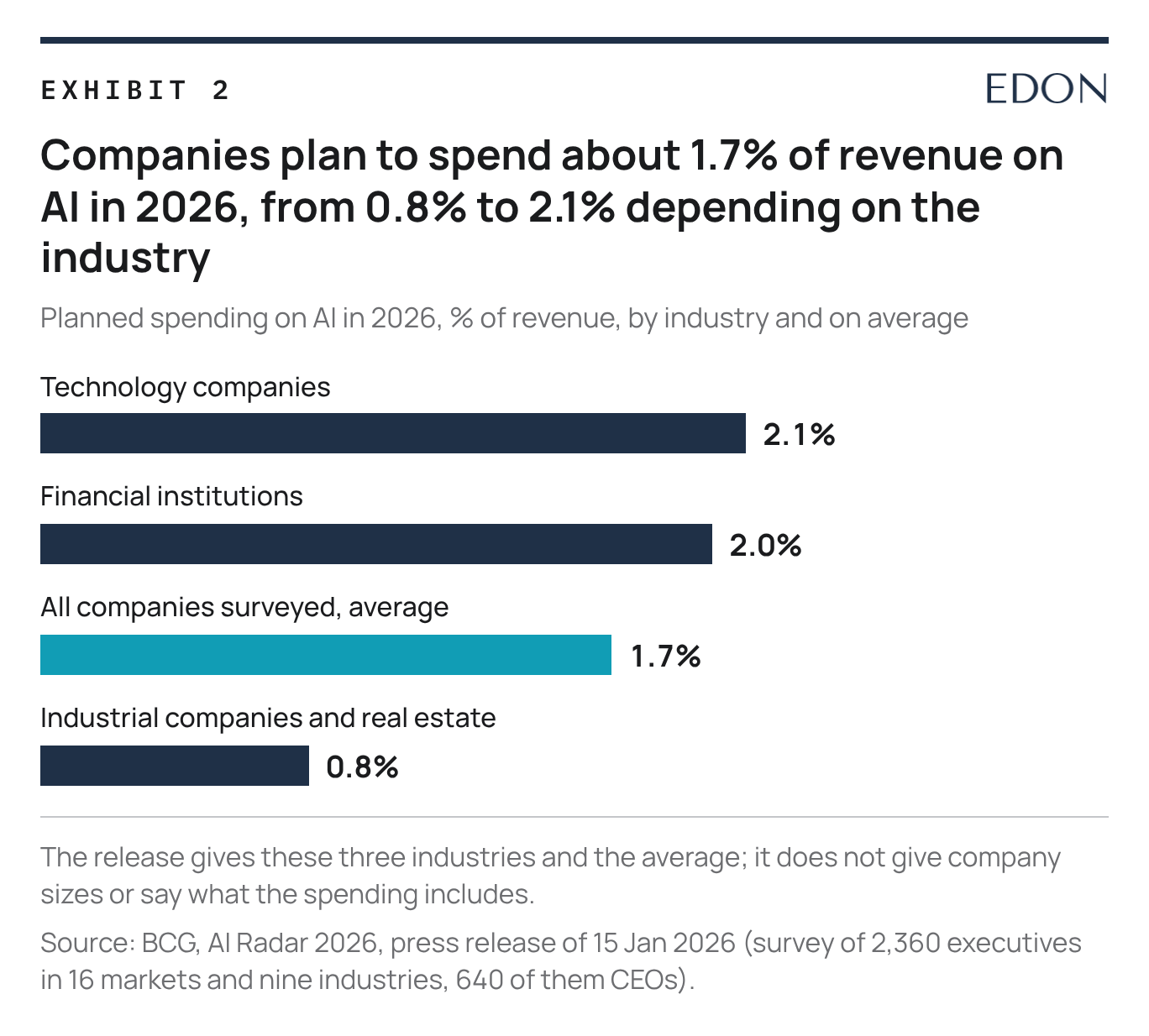
Exhibit 2. Companies plan to spend about 1.7% of revenue on AI in 2026, from 0.8% to 2.1% depending on the industry.
They pay for the change around the tool, and someone owns the result. Lever Talent's survey (opens in a new tab) of 484 leaders at US and Canadian companies with 100 to 999 staff, published on 22 October, found that 45% have no single owner for how people and AI work together. Companies with a primary owner were 2.5 times as likely as the rest to call AI extremely valuable. Companies investing only in AI technology reached that level 6% of the time; those investing across technology, programmes and people reached it 50% of the time (Exhibit 3).
McKinsey's high performers show the same habit. Nearly three-quarters of them had fundamentally redesigned workflows because of AI, against about a quarter of other respondents, and they were twice as likely to have defined processes for measuring the impact of their AI initiatives. Gartner's CEOs point the same way: 63% named a radical redesign of the operating model as a top move to speed up financial returns from AI, and Gartner's David Furlonger said the AI value problem "will not be solved by simply adding more AI" to existing ways of working. BCG's 2024 study (opens in a new tab) put numbers on the rule leaders follow, with 10% of resources for algorithms, 20% for technology and data and 70% for people and processes. In its 2026 survey, companies led by the CEOs it calls Trailblazers put 60% of their AI budgets into upskilling and retraining, against 27% and 24% in the other two groups.
Lever Talent warns that its findings describe associations, not cause and effect: companies that are good at change may simply be good at AI too. Four surveys with different samples and methods still point the same way, which is enough to budget by, if not to prove the case.
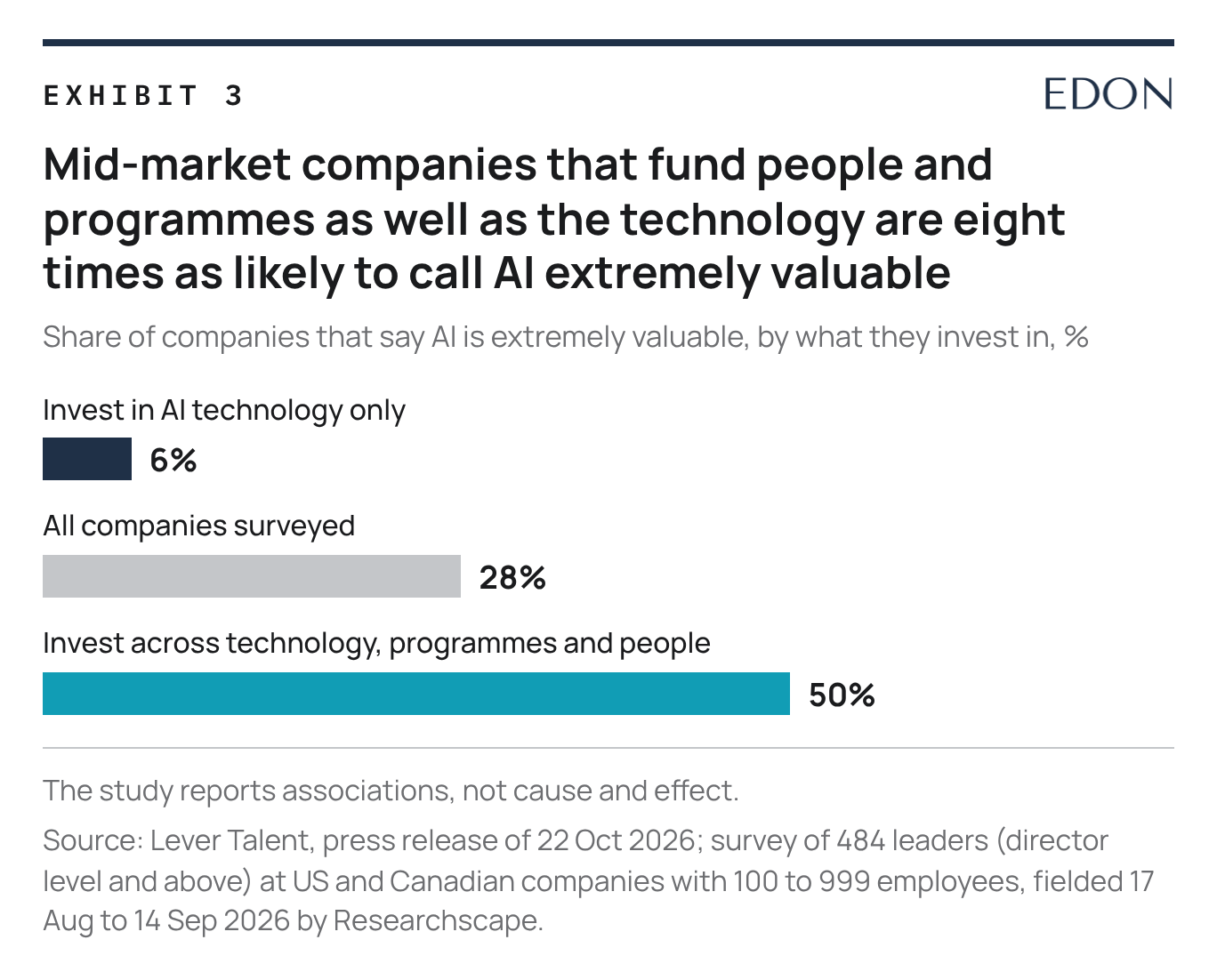
Exhibit 3. Mid-market companies that fund people and programmes as well as the technology are eight times as likely to call AI extremely valuable.
A staged AI budget is one in which each use case is a separate line, the money for a line is released only when three conditions are met, and every line is reviewed at mid-year. EDON suggests it for companies already past their first pilots (Exhibit 4).
Release what each line needs to reach the review. A line whose measure has moved and whose use is growing then gets the rest of its money. If use lags for a reason the owner can name, the plan changes before more money goes in; if nothing has moved and no credible fix exists, the money goes back to the pool. Alongside the lines, a small trial pot with a cap and an end date lets teams test ideas without a business case; a trial that wants to grow becomes a line and meets the same conditions.
The review matters because the budget is signed before most lines have run for a quarter. It gives the board a point to move money from lines that are not working to lines that are, without waiting for the 2028 round. It also answers BCG's 94%: a company that will keep funding AI whether or not it pays off needs a rule for when a line stops. In a mid-sized company the review can be one executive-team meeting; a large company with dozens of lines needs a portfolio view across its units.
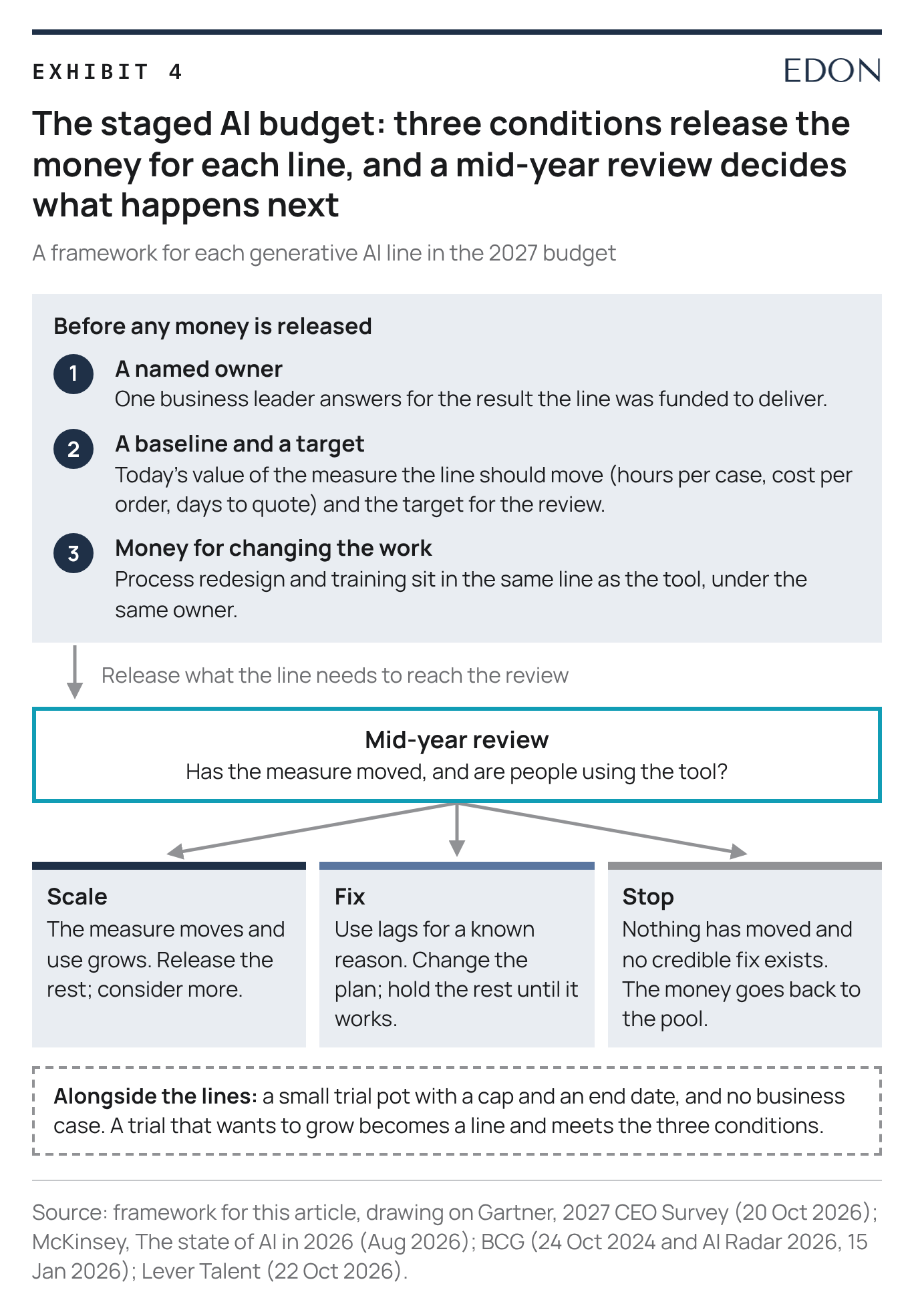
Exhibit 4. The staged AI budget: three conditions release the money for each line, and a mid-year review decides what happens next.
If a second view on your own lines would help, EDON offers a free 30-minute sparring session (opens in a new tab), with no obligation. Early in the work, EDON puts a high-value, usable deliverable in your hands, something you can act on and keep, before you commit further. We call it the Head Start.
When there is nothing to stage. A company with no AI in use yet has no lines to put through the conditions; its first question is whether and where to start. The approach also fits poorly where AI is the product: there the spending is product development, judged by the product's own economics. For small sums, such as a few dozen licences, the review costs more than it saves; treat them as ordinary software spending with a check on usage. And spending that regulation requires, such as compliance work on AI systems, should not pass through a gate that might stop it.
Ask to see the AI budget line by line, each with its owner, its baseline and its share for changing the work. Lines that fail a condition move to the trial pot or wait until they meet it. Set the date of the mid-year review now, before the money moves.
If this is on your desk right now, EDON offers a free 30-minute sparring session, with no obligation.
Related

