
Generative AI for Business · Transformation and Performance
If this is on your desk right now, EDON offers a free 30-minute sparring session, with no obligation.
Book 30 minutes (opens in a new tab)
This page is for owners, boards and CEOs of medium-sized and large companies in Finland whose cash is getting tight. Our answer: call for help before the company is insolvent, at the first firm warning sign. The first 30 days are about cash, because cash buys the time that every other decision needs.
Financial difficulty (talousvaikeudet) usually starts quietly: payment dates move, VAT goes out a few days late, and the bank asks for figures it never needed before.
The companies that gain most from a turnaround still have a real core: a product or service their customers keep buying. Many are owner-led; almost three in four Finnish companies are family firms (Aalto University via STT, 2026 (opens in a new tab)). The owner is often the CEO or the chair, and the bank is the most important outside stakeholder.
The pressure is widespread. About one Finnish SME in five reported difficulty paying its bills in autumn 2026 (Suomen Yrittäjät, 2026 (opens in a new tab)). Trade and construction led bankruptcy filings in August 2026 (Statistics Finland, September 2026 (opens in a new tab)), and 3,906 bankruptcies were filed in 2025 (Statistics Finland, 2026 (opens in a new tab)).
Earlier than most owners think. Call at the first of these:
The latest moment is before the company is insolvent. Once it cannot pay its debts as they fall due, the choice narrows to formal restructuring (yrityssaneeraus) or bankruptcy, and the first call should go to an insolvency lawyer. EDON can then work on the cash alongside the lawyer.
If one of these is true today, book a free 30-minute sparring session with EDON (opens in a new tab) this week.
Three signals separate a turnaround from a budget problem. Each means that cash and the trust of the people who fund the business are slipping together:
Good people leaving the management team is often an earlier, softer sign (PwC, 2026 (opens in a new tab)). Our rule of thumb: when two of the three signals hold, a better budget will not fix it.
EDON's turnaround method has four stages. The first, Anchor, covers the first 30 days of a cash crisis, or kassakriisi (Exhibit 1).
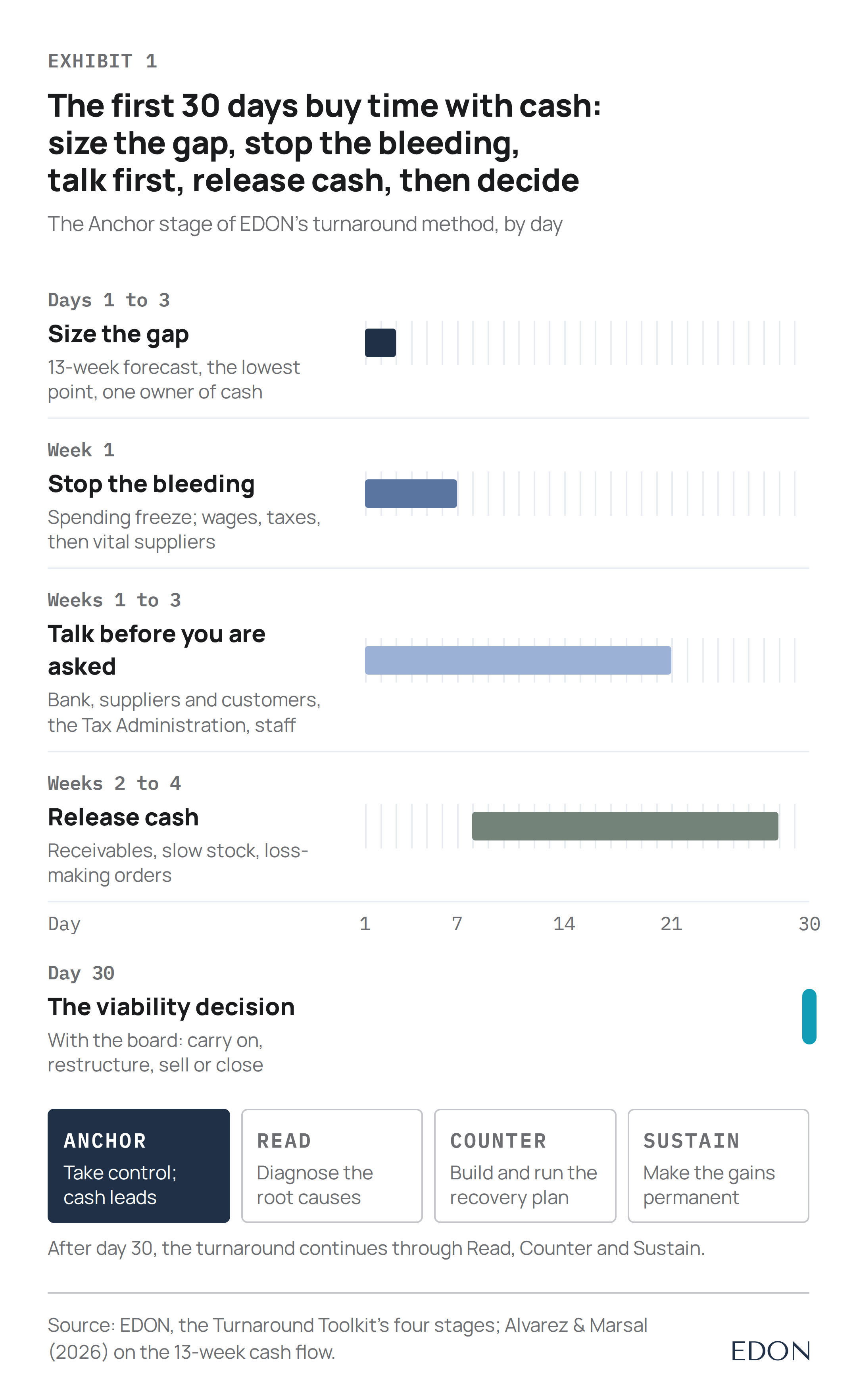
Exhibit 1. The first 30 days buy time with cash: size the gap, stop the bleeding, talk first, release cash, then decide.
Owner families decide fast but cut late. In family companies decisions are short and direct, yet a strong sense of personal responsibility often delays layoffs (Family Business Magazine, 2026 (opens in a new tab)), and owners of smaller firms say they feel alone when the crisis bites (COWI for the Danish Business Authority, 2022 (opens in a new tab)).
Trust in outside help is low. Many companies have relied for years on the same individual advisers, often not hands-on consultants, who no longer add much value, and owners rarely look elsewhere because these are the people they are used to. In a crisis that habit costs time: a fresh outside view is most useful exactly when it feels least natural to ask for one.
The board's duties are concrete. Negative equity must be registered without delay, yet only one company in five with negative equity in 2021 to 2023 filed the notice (Finnish Tax Administration, 2025 (opens in a new tab)).
Formal restructuring now has an earlier door. Since July 2022 a company threatened with insolvency can apply for early restructuring itself, with a stay of three months that can be extended to twelve (Act 386/2022 (opens in a new tab)). Courts confirmed 134 restructuring programmes in 2025 (Statistics Finland, 2026 (opens in a new tab)), but most companies that enter restructuring still end in bankruptcy (Suomen Yrittäjät, 2018 (opens in a new tab)), so the informal work should start well before.
Staff rules are lighter than they were. Since 1 July 2025 the Co-operation Act applies in full only from 50 employees, and the minimum negotiation periods are 7 days or 3 weeks (Ministry of Economic Affairs and Employment, 2025 (opens in a new tab)).
From Kave Asad's experience: a sanitaryware manufacturer with a long-standing, market-leading brand was losing money on every product it sold. The cost of goods was already higher than the selling price.
All of this ran while the company was being prepared for a sale.
EDON is a strategy and transformation firm based in Finland, and turnarounds are part of its transformation and performance work. Early in the work, EDON puts a high-value, usable deliverable in your hands, something you can act on and keep, before you commit further. We call it the Head Start.
Each engagement is scoped around the decisions in front of the owners and the board: what has to be decided, by when, and what you will hold at the end. Scope and deliverables are agreed in writing before the work starts, and we work alongside your lawyer, auditor and bank.
If you would rather start on your own, the free Turnaround Toolkit sets out the four stages and the tools for each.
What is the difference between a turnaround and formal restructuring? A turnaround is the company's own programme to restore cash and profit, led by the owners and management. Formal restructuring (yrityssaneeraus) is a court procedure, with a stay on creditors and a programme the court confirms (Ministry of Justice, unofficial translation (opens in a new tab)). Many turnarounds never need a court.
How early is too early to call? It is almost never too early. The best moment is when the 13-week forecast first shows a shortfall, while there are still weeks to act.
What should we tell the bank, and when? Tell it early, before it asks, and bring the 13-week forecast and the plan. Banks consider a repayment holiday when the company brings current figures (Nordea (opens in a new tab)), and Finnvera can grant one on its own loans (Finnvera (opens in a new tab)).
Is there free help? Yes. Yrittäjän talousapu, run by the KEHA Centre, gives free and confidential advice to entrepreneurs in financial difficulty (KEHA Centre (opens in a new tab)).
If this is on your desk right now, EDON offers a free 30-minute sparring session, with no obligation.
Related


Resources for this capability
Four stages, from the first 30 days of cash control to the board’s role once the crisis has passed. Free to read.
