
Strategy · M&A, Partnerships and Market Entry
If this is on your desk right now, EDON offers a free 30-minute sparring session, with no obligation.
Book 30 minutes (opens in a new tab)
To turn around a struggling company, act on the warning signs before the bank does, and let cash lead. Start by finding out how many weeks of cash are left; a 13-week cash forecast tells you. Then work through four steps: analyse, strategise, take action and evaluate.
This is for the owners, CEOs, boards and investors of young and growing companies, and of established, owner-led firms where decline is slow and easy to miss. Finland saw 3,906 bankruptcy proceedings instituted in 2025, the most since 1996 (Yle (opens in a new tab)), up from 3,488 in 2024 and 62% more than in 2016 (Statistics Finland (opens in a new tab)). From January to August 2026 there were 2,703 (Statistics Finland (opens in a new tab)), 4% more than a year earlier; at that pace, 2026 would end at about 4,080.
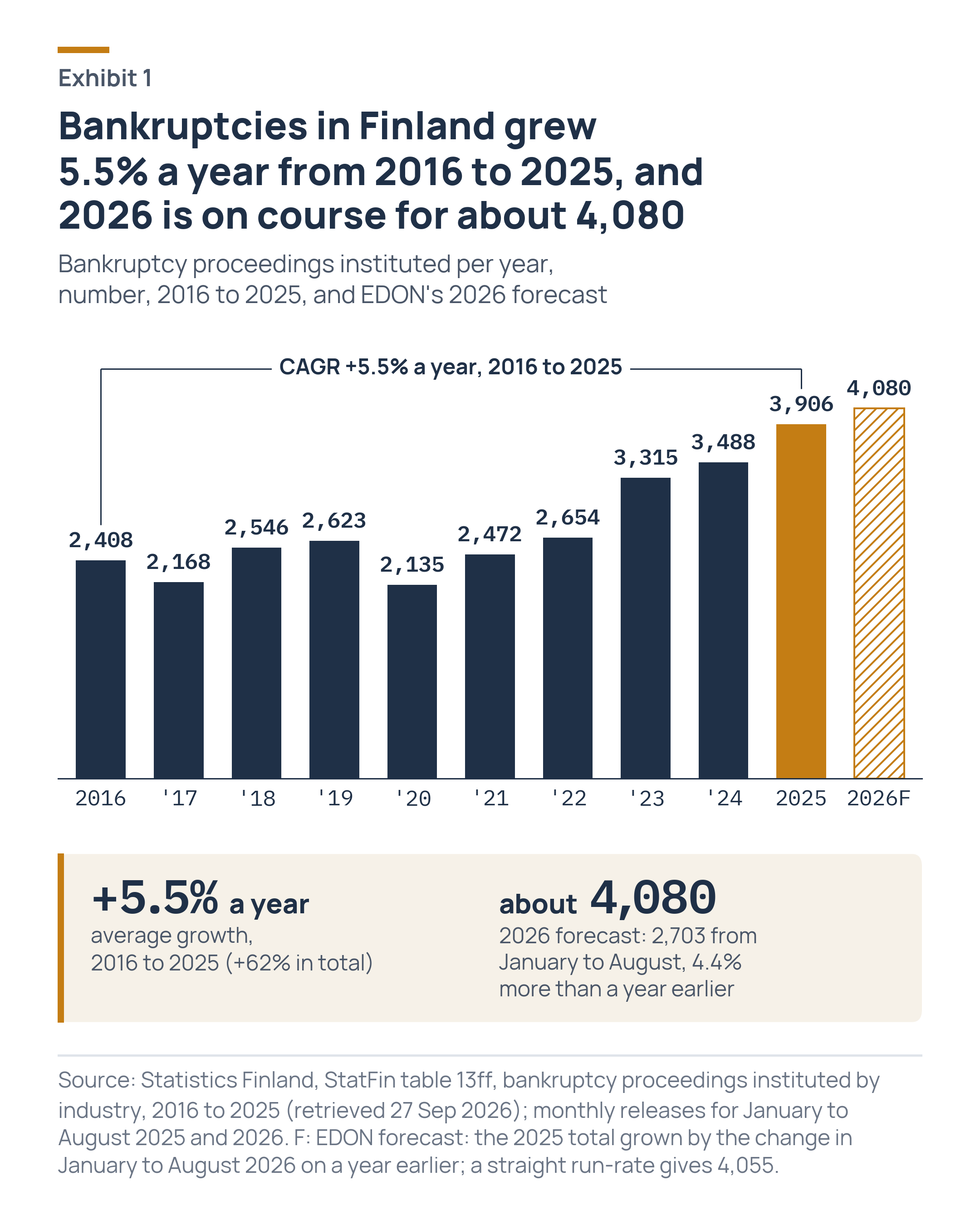
Exhibit 1. Bankruptcies in Finland grew 5.5% a year from 2016 to 2025, and 2026 is on course for about 4,080. Bankruptcy proceedings instituted in Finland per year, number, 2016 to 2025, with EDON's 2026 forecast. Source: Statistics Finland, StatFin table 13ff (retrieved 27 Sep 2026) and monthly releases for January to August 2025 and 2026; forecast: EDON, the 2025 total grown by the change in January to August 2026 on a year earlier.
Entrepreneurs often dream big: a respectable IPO and a seat at the table with the likes of Page, Brin and Zuckerberg. For most start-ups, that remains a pipedream. Not to burst your bubble, but even survival is far from certain: in Finland, 56% of the enterprises born in 2018 were still active five years later (Eurostat (opens in a new tab)). Business, like life, is a numbers game, which means you have to be smart about how you play the numbers.
EDON's own 13-week cash forecast is free after a short form: an Excel workbook with a worked example, in the Turnaround Toolkit.
A turnaround strategy is the plan that takes a loss-making or cash-short company back to solvency, then to profit, while it keeps trading. The aim is to stop the decline without stopping the business, and to avoid liquidation.
Usually one or more of these:
Decline in an established company can take years; in a young one, sudden events can bring it on within months. The signs often show in cash before they show in profit:
These are usually symptoms of deeper strategic and operational trouble; left alone, they start a vicious cycle of decline that ends in failure or liquidation. One sign is a warning; two or three together are a reason to build the cash forecast this week.
If you recognise your company in this list and want a second pair of eyes, EDON offers a free 30-minute sparring session (opens in a new tab). There is no obligation, and if someone else is better placed to help, EDON will tell you who.
Profit tells you whether the business works; cash tells you how long you have to fix it. A 13-week cash forecast is a week-by-week view of the cash coming in and going out over the next quarter, reviewed every week. Build one before any analysis: it shows the week your cash is lowest and whether that low point is above the minimum you need to operate. Work back from that week to the first decisions: which payments to renegotiate and which costs stop this month.
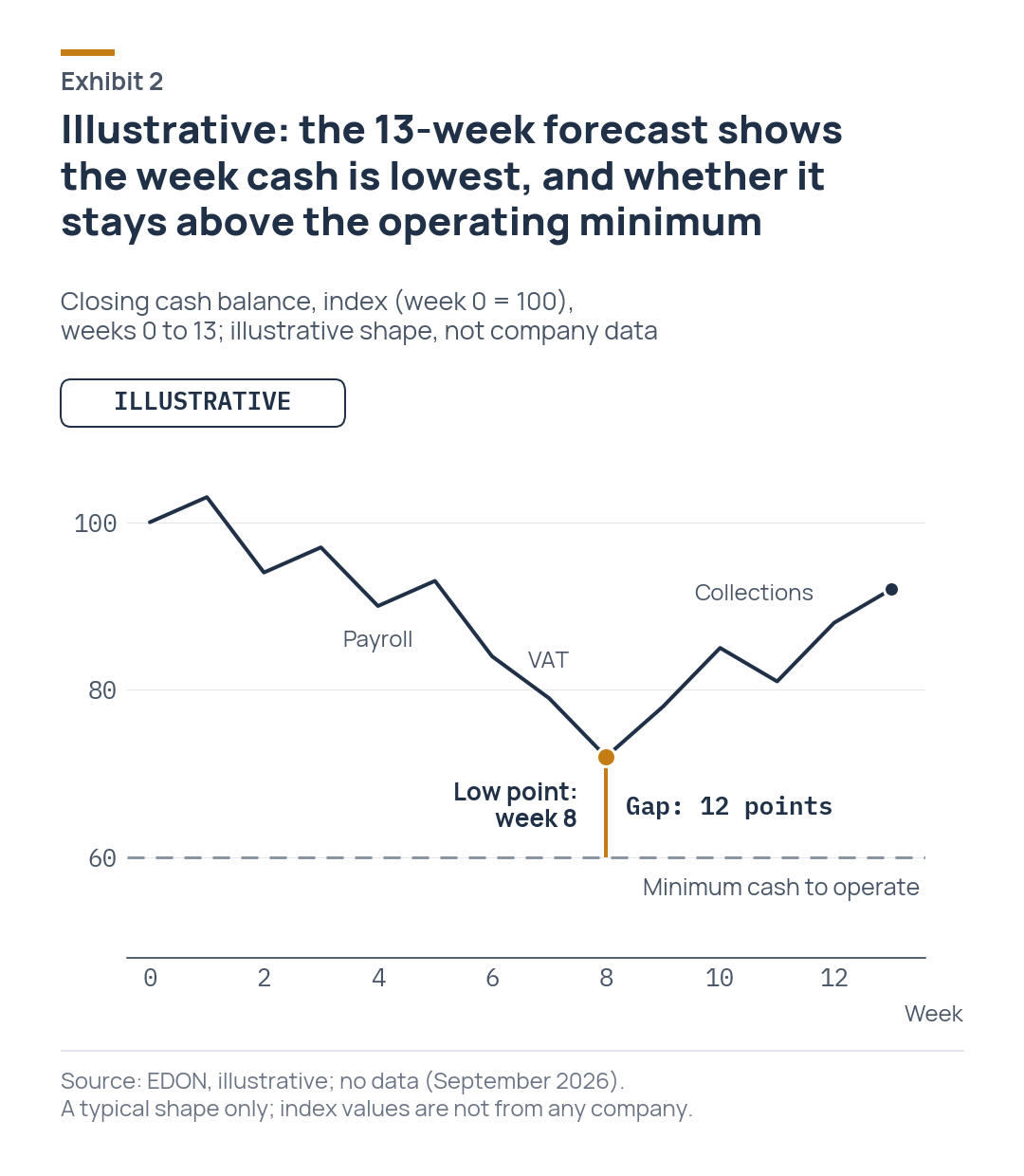
Exhibit 2. Illustrative: the 13-week forecast shows the week cash is lowest, and whether it stays above the operating minimum. Closing cash balance as an index (week 0 = 100), weeks 0 to 13, with the minimum cash needed to operate. Illustrative shape only, not company data. Source: EDON, illustrative; no data (September 2026).
Stopping the bleeding is the first phase of a turnaround: bringing cash under control so there is time to fix the causes.
EDON's Turnaround Toolkit starts here: its first stage, Anchor, puts cash under control with a 13-week cash forecast and the daily and weekly routine around it.
Turnaround strategies are easier said than done. Once cash is under control, the work has four steps. EDON's Turnaround Toolkit covers the same ground in four stages, called ARCS: Anchor, Read, Counter and Sustain. Exhibit 3 shows how they line up.
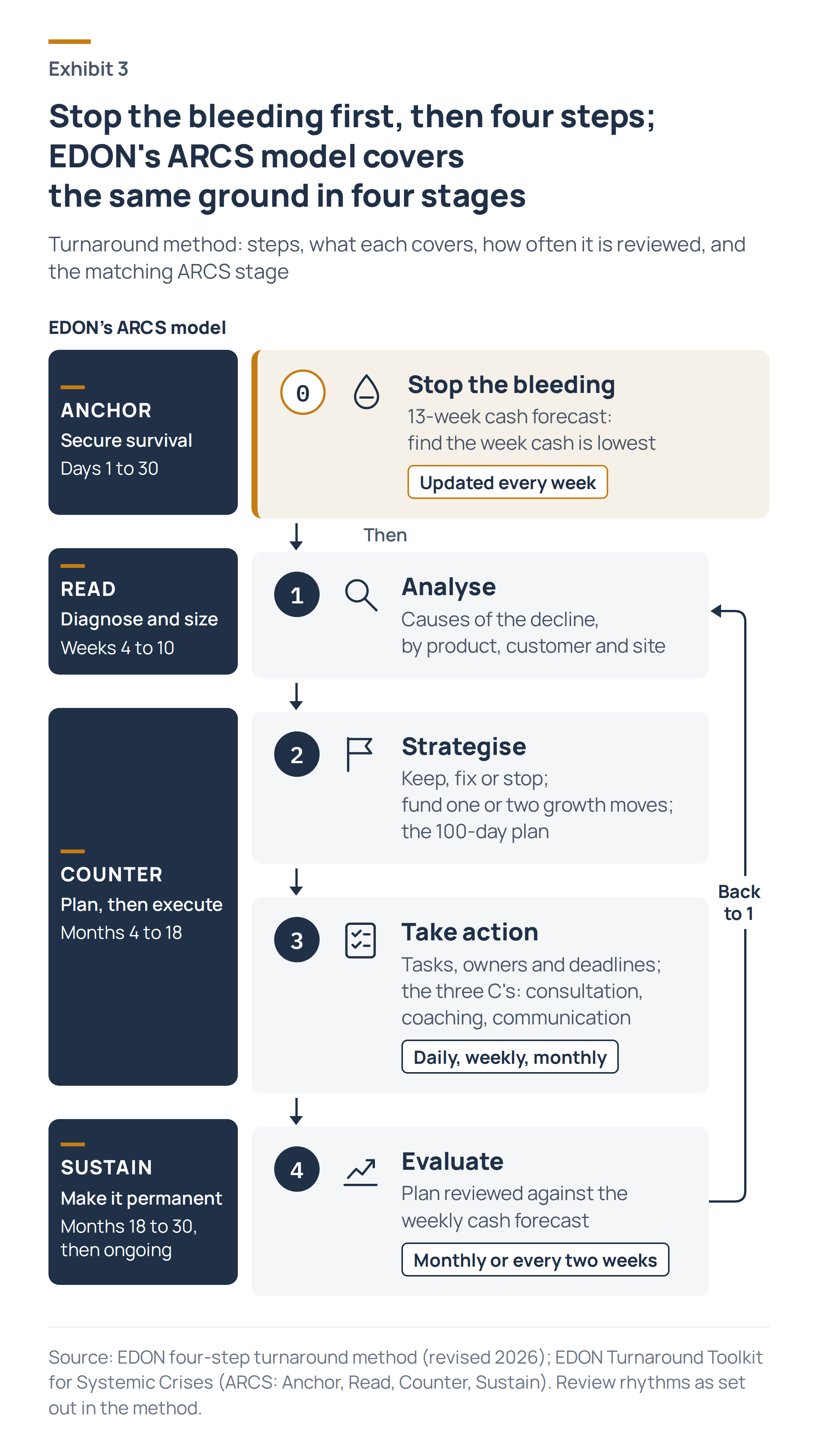
Exhibit 3. Stop the bleeding first, then four steps; EDON's ARCS model covers the same ground in four stages. Turnaround method: stage 0, stop the bleeding with a 13-week cash forecast updated every week; then 1 Analyse, 2 Strategise, 3 Take action and 4 Evaluate, with a loop from 4 back to 1; alongside, ARCS: Anchor (stop the bleeding), Read (analyse), Counter (strategise and take action) and Sustain (evaluate). Source: EDON four-step turnaround method (revised 2026); EDON Turnaround Toolkit for Systemic Crises.
Find where the company loses money and why, by product, customer and site. The plan is built on those causes; the symptoms only show where to look.
An outside view helps here. Founders and long-serving CEOs know the business deeply, and that depth can hide causes they have lived with for years. A board member, an investor, an interim manager or a turnaround adviser who has worked across functions brings a "fresh eye".
Sort what the analysis found into three lists, by product, customer and site: what you keep, what you fix and what you stop. Then choose the one or two moves that will grow the business, and fund them from what you stop. Doing both at once pays: in a study of 4,700 public companies across three recessions, those that cut costs selectively while investing in marketing, R&D and new assets had a 37% chance of pulling ahead of their rivals afterwards, against 21% for those that mainly cut (Gulati, Nohria and Wohlgezogen, Harvard Business Review, 2010 (opens in a new tab)). EDON calls this the dual track. Before you commit, run a premortem: imagine it is a year from now and the plan has failed, and have each person write down why (Gary Klein, Harvard Business Review, 2007 (opens in a new tab)). The toolkit's 100-day plan puts the resulting initiatives on one page, by workstream.
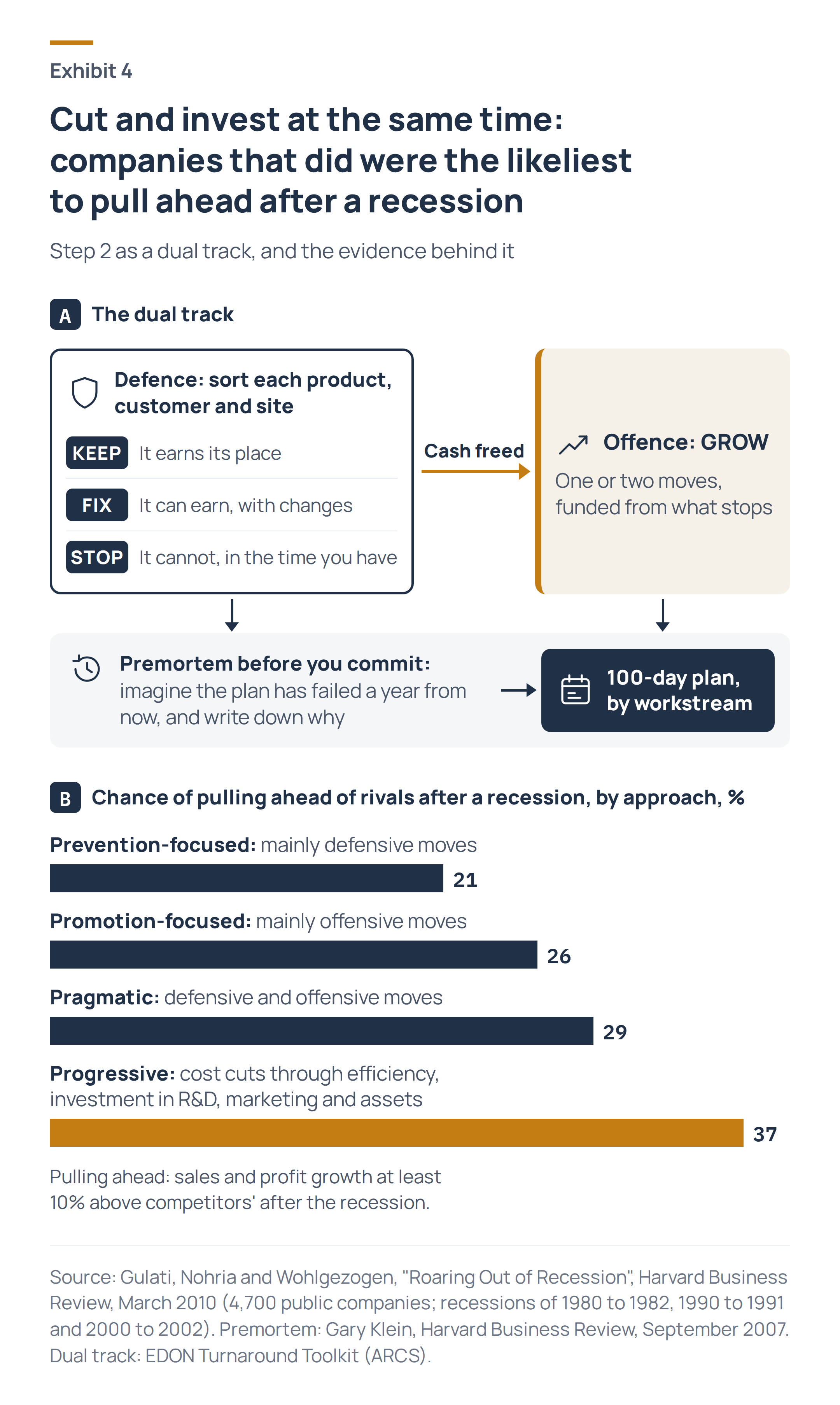
Exhibit 4. Cut and invest at the same time: companies that did were the likeliest to pull ahead after a recession. Step 2 as a dual track (defence: keep, fix or stop each product, customer and site; offence: one or two growth moves funded from what stops; a premortem before the 100-day plan), and the chance of pulling ahead of rivals after a recession, by approach: prevention-focused 21%, promotion-focused 26%, pragmatic 29%, progressive 37%. Source: Gulati, Nohria and Wohlgezogen, Harvard Business Review, March 2010 (4,700 public companies, three recessions); Gary Klein, Harvard Business Review, September 2007; EDON Turnaround Toolkit.
Now put the strategy to the test with a clear, concise action plan: tasks, owners and deadlines, worked through daily, weekly and monthly.
The plan also needs the people who carry it out, which is where the three C's come in: consultation, coaching and communication. A plan that works on paper can still fail in the organisation. Consult the people who must carry it, coach them through the new work, and tell them every week what is happening.
Regular reviews keep the plan on track and show which corrective actions are needed. In the first phase, while you stop the bleeding, review the plan every month, or every two weeks, against a cash forecast you update every week.
Sometimes. Make no mistake: a turnaround involves hard, sometimes controversial decisions, and one of them may be a new CEO or an external turnaround specialist. In a study of 212 American start-ups from the late 1990s and early 2000s, Noam Wasserman found that half of the founders were no longer CEO by the company's third year (Harvard Business Review, 2008 (opens in a new tab)). If an interim manager steps in, plan the handover from the first day.
When the cash forecast shows the company cannot pay its debts as they fall due, even after every fix you can make in time. Then call an insolvency lawyer before you call a strategist; in Finland that means weighing a court-supervised restructuring (yrityssaneeraus) against a sale or bankruptcy. It is also the wrong move when the market has gone for good: a sale or an orderly closure may protect more for owners, staff and creditors. And a young company that loses money on purpose, with funded runway and a plan it is meeting, does not need a turnaround. It is investing.
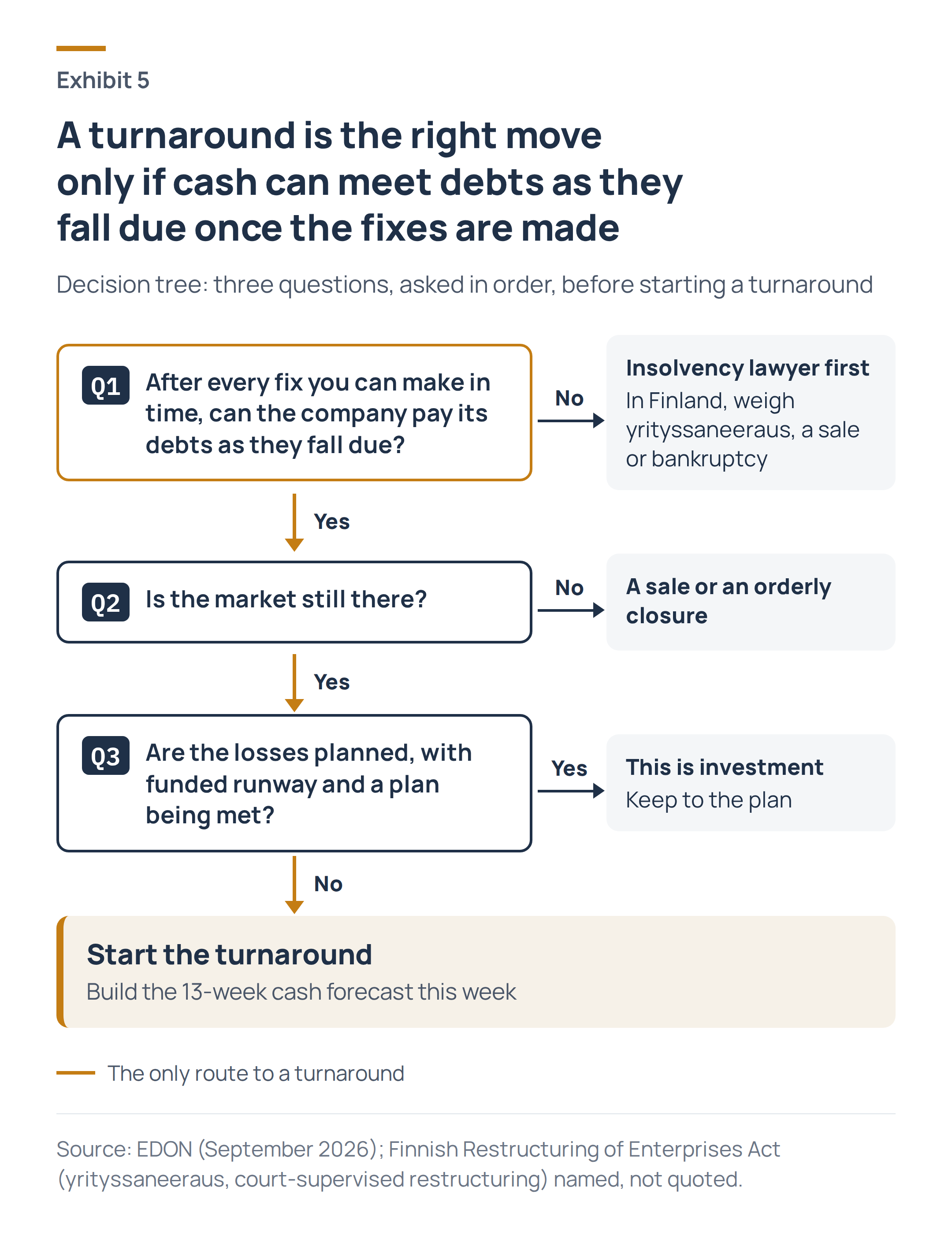
Exhibit 5. A turnaround is the right move only if cash can meet debts as they fall due once the fixes are made. Decision tree: three questions, asked in order, before starting a turnaround. Source: EDON (September 2026); Finnish Restructuring of Enterprises Act (yrityssaneeraus) named, not quoted.
Build the 13-week cash forecast, find the week your cash is lowest, and list the decisions that week forces. Start improving the company today, so that it can brave the elements and stay afloat well into the future.
EDON's approach to turnarounds is on its turnaround and performance page.
First published on LinkedIn on 26 May 2016. Revised on 29 September 2026. Read the original (opens in a new tab)
If this is on your desk right now, EDON offers a free 30-minute sparring session, with no obligation.
Related


Resources for this capability
Four stages, from the first 30 days of cash control to the board’s role once the crisis has passed. Free to read.
