
Strategy · M&A, Partnerships and Market Entry
If this is on your desk right now, EDON offers a free 30-minute sparring session, with no obligation.
Book 30 minutes (opens in a new tab)
For a company growing past 250 staff, the EU's small mid-cap category would soften the step from SME to large company in a few places, chiefly data protection records and the prospectus. SME status and SME-only aid would not change. The saving is small for most companies; growth and deal plans still turn on the business case.
The rules are agreed but not yet law. The European Parliament and the Council reached a provisional agreement (opens in a new tab) on 9 June 2026, which the member states' ambassadors confirmed on 26 June and the Parliament's committee on 2 July. As of 26 October 2026, the Parliament's vote is forecast for its plenary of 23 November (Legislative Observatory (opens in a new tab)); the Council then adopts the acts, which enter into force on the 20th day after publication in the Official Journal.
A small mid-cap, as agreed, is a company that is no longer an SME, employs fewer than 1,000 people and has an annual turnover of up to EUR 200 million or a balance sheet of up to EUR 172 million. The Commission had proposed 750 staff, EUR 150 million and EUR 129 million, the figures in its recommendation of May 2025 (opens in a new tab); the Parliament and the Council raised all three.
The new class sits between two lines that do not move. Below it, the SME definition (opens in a new tab) still applies: fewer than 250 staff and up to EUR 50 million turnover or EUR 43 million balance sheet. Above it, a company with 1,000 or more staff, or above both financial ceilings, is large. The staff and figures of linked and partner companies count towards the ceilings, and status changes only after a ceiling has been crossed in two consecutive accounting periods.
The step is common: around one in five small mid-caps was an SME three years earlier, according to the agreed regulation (opens in a new tab).
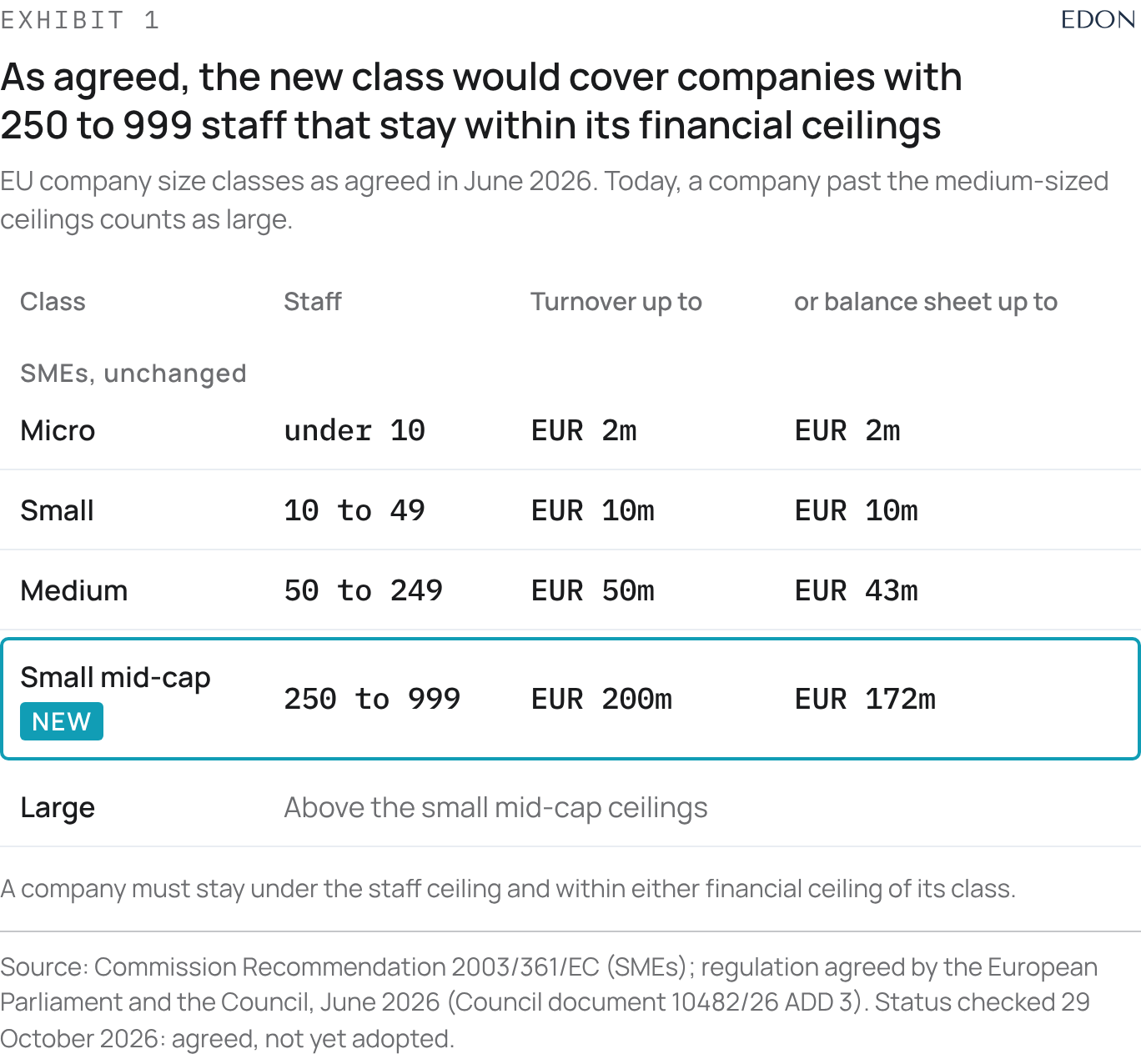
Exhibit 1. As agreed, the new class would cover companies with 250 to 999 staff that stay within its financial ceilings. Source: Commission Recommendation 2003/361/EC (SMEs); regulation agreed by the European Parliament and the Council, June 2026 (Council document 10482/26 ADD 3). Status checked 29 October 2026: agreed, not yet adopted.
Six, each with its own test (Exhibit 2). Three matter to most growing companies.
Data protection records. Today the GDPR exempts organisations with fewer than 250 staff from keeping a record of processing, but only if their processing is occasional, unlikely to put people's rights at risk and free of sensitive data. Employers process staff data all year round, so in practice the exemption has been unusable, as the Finnish Government noted in its letter to Parliament of July 2025 (opens in a new tab). As agreed, any organisation with fewer than 1,000 staff, SME or not, would need a record only for processing likely to result in a high risk, or processing that makes a data protection officer mandatory.
The shorter prospectus. The EU Growth issuance prospectus is open today to SMEs, to companies on an SME growth market and to unlisted companies with up to 499 staff that offer less than EUR 50 million (ESMA (opens in a new tab)). As agreed, small mid-caps would qualify for an offer of any size, provided they have no securities on a regulated market.
Growth markets. At least half of the companies on an SME growth market must be SMEs. Companies with an average market value of EUR 200 million to EUR 1 billion would count towards that half, so a growth market could keep companies valued above EUR 200 million and still meet the test.
The other three are narrower. Battery due diligence duties would start at EUR 200 million turnover instead of EUR 40 million, the SME helpdesk for trade defence cases would serve small mid-caps too, and national strategies for critical entities would describe support for small mid-caps.
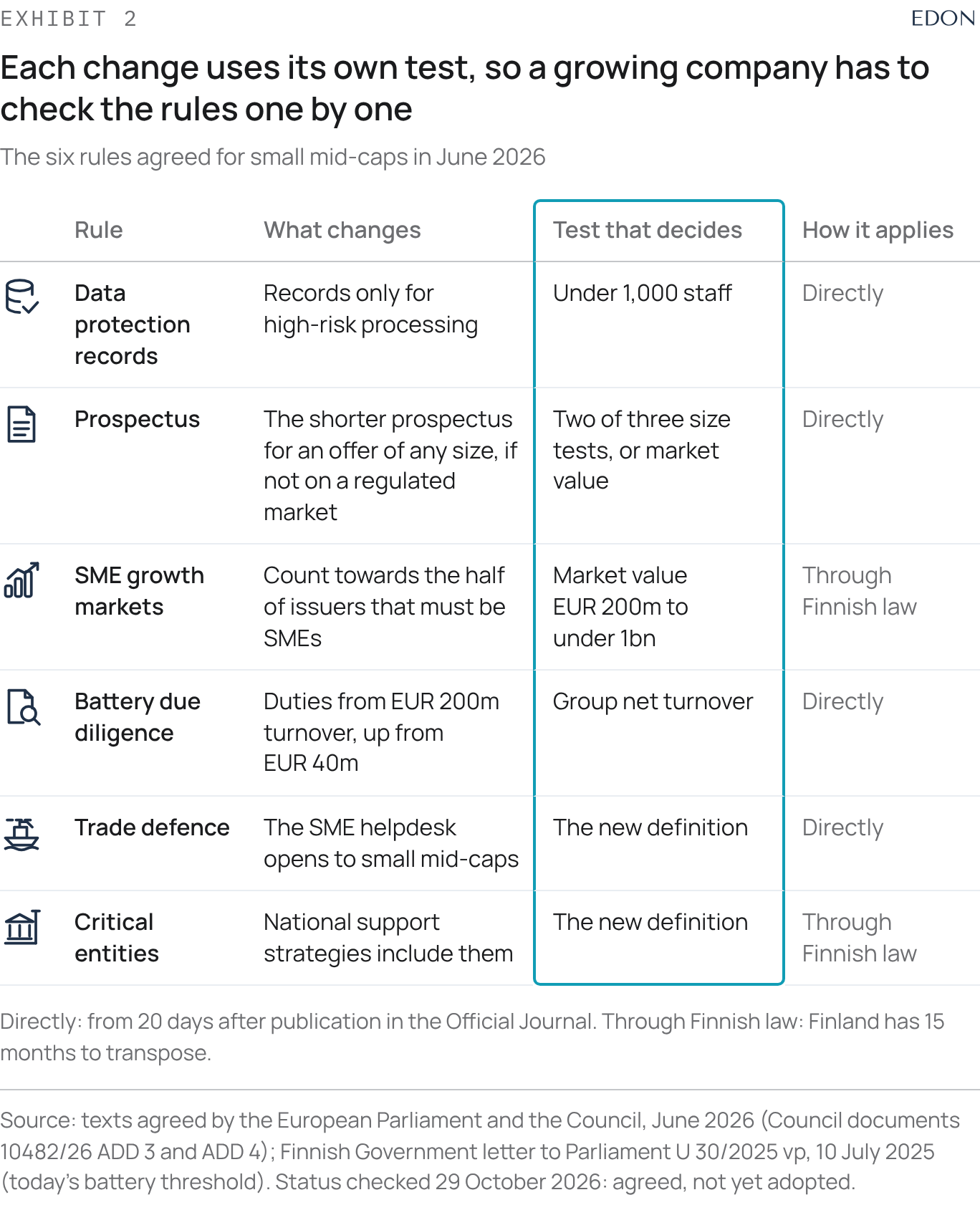
Exhibit 2. Each change uses its own test, so a growing company has to check the rules one by one. Source: texts agreed by the European Parliament and the Council, June 2026 (Council documents 10482/26 ADD 3 and ADD 4); Finnish Government letter to Parliament U 30/2025 vp, 10 July 2025 (today's battery threshold). Status checked 29 October 2026: agreed, not yet adopted.
Little, for most companies. On the Commission's estimates, the average small mid-cap would save about EUR 2,100 to 2,500 a year: EUR 79 million to 93 million in all, spread over about 38,000 companies, as the Finnish Government's letter to Parliament (opens in a new tab) reports. The data protection change, which concerns every employer in the class, was valued at about EUR 560,000 a year for all of them together.
The larger sums sit in capital markets. The estimate for the shorter prospectus rests on about 635 companies, each saving EUR 20,000 to 35,000. In Finland, the Government put the saving for all small mid-caps at EUR 1.0 million to 1.1 million a year. These estimates were made for the Commission's lower ceilings; the agreed class is wider.
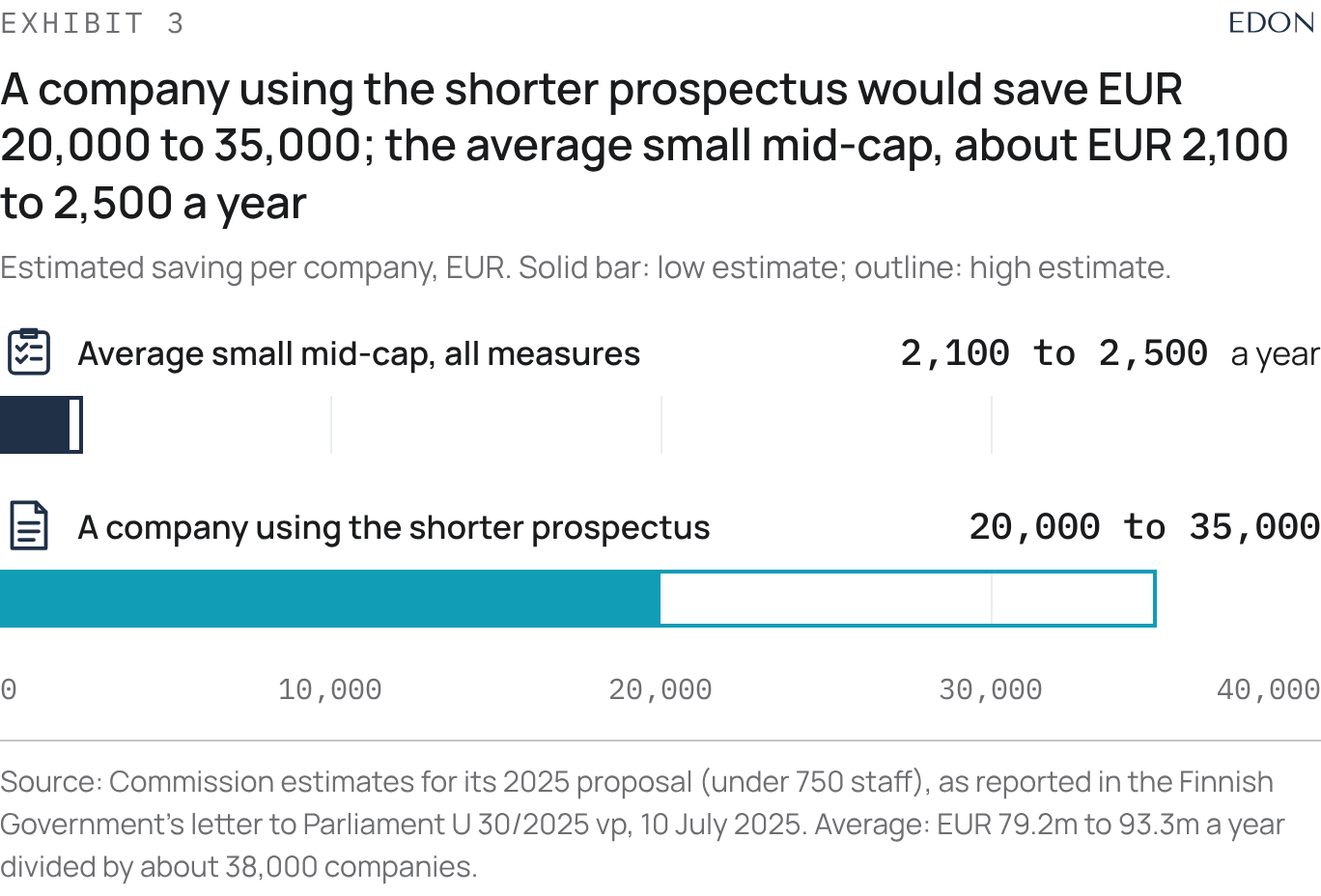
Exhibit 3. A company using the shorter prospectus would save EUR 20,000 to 35,000; the average small mid-cap, about EUR 2,100 to 2,500 a year. Source: Commission estimates for its 2025 proposal (under 750 staff), as reported in the Finnish Government's letter to Parliament U 30/2025 vp, 10 July 2025; average calculated from those estimates.
Most of what makes 250 staff a real line. SME status still ends once a company has been above the SME ceilings for two consecutive accounting periods, and with it the SME terms in EU programmes and State aid. The Commission's recommendation leaves State aid thresholds as they are, and Finland's Government argued that the new definition should not be extended to financial support.
Other 250-staff lines stay too. Under the EU's pay transparency directive (opens in a new tab), employers with 250 or more workers must report their gender pay gap every year. In Finland, the Tax Administration (opens in a new tab) expects the first reports under the government's bill, on 2027 pay, in May 2028. In an acquisition, the target's staff and figures count in the buyer's, so a single deal can take a group past the line.
The GDPR's other duties remain, and the EU's data protection authorities note that the record of processing is a means to show compliance (EDPB and EDPS, July 2025 (opens in a new tab)), so many companies of this size may keep one anyway.
The parts that touch the company itself sit in the regulation, which would apply in Finland directly once in force: data protection records, the prospectus, batteries and trade defence.
The directive covers growth markets and critical entities. Finland would have 15 months from entry into force to transpose it, and the Government's letter gives the Securities Markets Act as an example of a law to amend. EDON found no published Finnish project for this when it checked on 26 October 2026. For a company, this part matters through its trading venue: Nasdaq First North Growth Market (opens in a new tab) is registered as an SME growth market.
In Finland the class is small: Statistics Finland counted 391 companies with 250 to 499 staff in 2023, the figure behind the Government's estimate (opens in a new tab); the agreed class adds those with 500 to 999 staff.
For most companies, very little (Exhibit 4). A hiring plan that takes a company past 250 staff still stands or falls on the market and the margin; the agreed rules would save a few thousand euros a year, and SME status ends on the same schedule as before. Where a group relies on SME-only support, the loss of SME status belongs in the acquisition case. The category does change how a company can raise capital: before a public share offer, it is worth checking whether the shorter prospectus or a growth-market listing would be open to it under the published texts. In an owner-led company, bringing in outside shareholders is first a question for the owner strategy.
EDON suggests a one-page threshold map: each duty that depends on size, the test it uses (staff, turnover, balance sheet or market value), where the company stands today and where its plan takes it. It shows which savings are real and which lines the plan will cross. If you are planning a hiring wave, a deal or a share offer near these lines, EDON offers a free 30-minute sparring session, with no obligation: edon.fi/book (opens in a new tab).
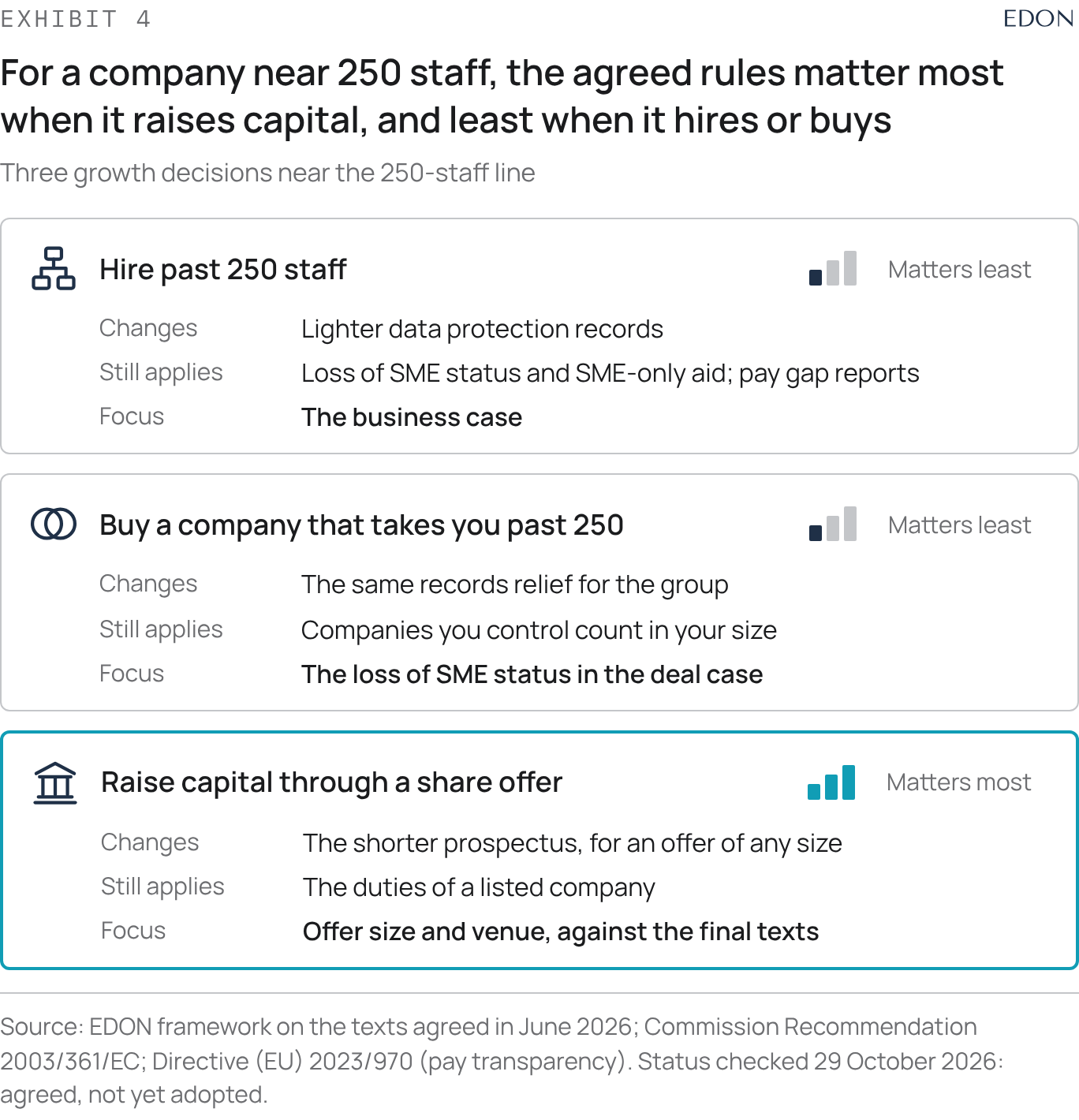
Exhibit 4. For a company near 250 staff, the agreed rules matter most when it raises capital, and least when it hires or buys. Source: EDON framework on the texts agreed in June 2026; Commission Recommendation 2003/361/EC; Directive (EU) 2023/970 (pay transparency). Status checked 29 October 2026: agreed, not yet adopted.
Planning on the business case alone does not fit every company. One that places batteries on the EU market with a turnover between EUR 40 million and EUR 200 million would no longer face the battery due diligence duties at all. One whose growth relies on SME-only aid or SME terms in EU programmes is better off timing the step past 250 staff with its funders, because the new class does not carry those terms with it.
This article describes rules as agreed, not as adopted, and it is not legal advice. Before a decision rests on them, the final texts are worth checking with a legal adviser.
The decision for now is narrow: which of the changed rules apply to your company, and what each is worth, before next year's plan is signed off. Growth and deal options can then be judged on their merits, and the route to capital revisited once the acts are in the Official Journal.
EDON, a strategy and transformation firm based in Finland, works with owners and boards on growth plans and acquisitions, alongside their legal and financial advisers. Its capability pages on strategy and mergers, acquisitions and market entry go into more detail.
If this is on your desk right now, EDON offers a free 30-minute sparring session, with no obligation.
Related


Resources for this capability
Six stages, from an honest baseline and an emergency plan to the reviews that keep the handover standing. Free to read.
