
Strategy · M&A, Partnerships and Market Entry
If this is on your desk right now, EDON offers a free 30-minute sparring session, with no obligation.
Book 30 minutes (opens in a new tab)
When a family company has to hand over and turn around at once, EDON suggests treating ownership, the board and the CEO as three separate decisions. The family can keep the first two and pick the CEO for the turnaround. In Danish research, family successions cut operating profitability by at least four percentage points against outside ones.
In Finland, family firms make up 73% of companies and provide 42% of the jobs in them, according to Aalto University research of 10 February 2026 (opens in a new tab). In a survey of 880 family firms in September 2024 (opens in a new tab) (in Finnish), more firms whose owner has turned 60 planned a succession within the family than in 2021: 36% of respondents, against 31%.
On average, the strongest evidence says it does. Bennedsen, Nielsen, Pérez-González and Wolfenzon studied 5,334 CEO successions in Danish limited liability firms between 1994 and 2002 (Quarterly Journal of Economics, 2007 (opens in a new tab); figures from the NBER working paper of July 2006 (opens in a new tab)). A third of them, 1,776, went to a relative of the departing CEO.
Before the handover (Exhibit 1), the firms that chose a family CEO earned an operating return on assets 0.77 percentage points above their industry's. Over the three years after it, that edge slipped to 0.67. The firms that hired an outsider started 0.85 points below their industry and ended 0.46 points above it, a gain of 1.3 points.
Outsiders tended to take over weaker firms, so a raw comparison mixes the CEO's effect with each firm's starting point. To isolate the effect, the authors used the sex of the departing CEO's first child: a firstborn son makes a family succession more likely but is unlikely to change the firm's prospects in any other way. Measured this way, the effect was larger. Operating profitability fell by at least four percentage points after a family succession, compared with an outside one, and the fall was largest in fast-growing industries, in industries with highly skilled workers and in relatively large firms.
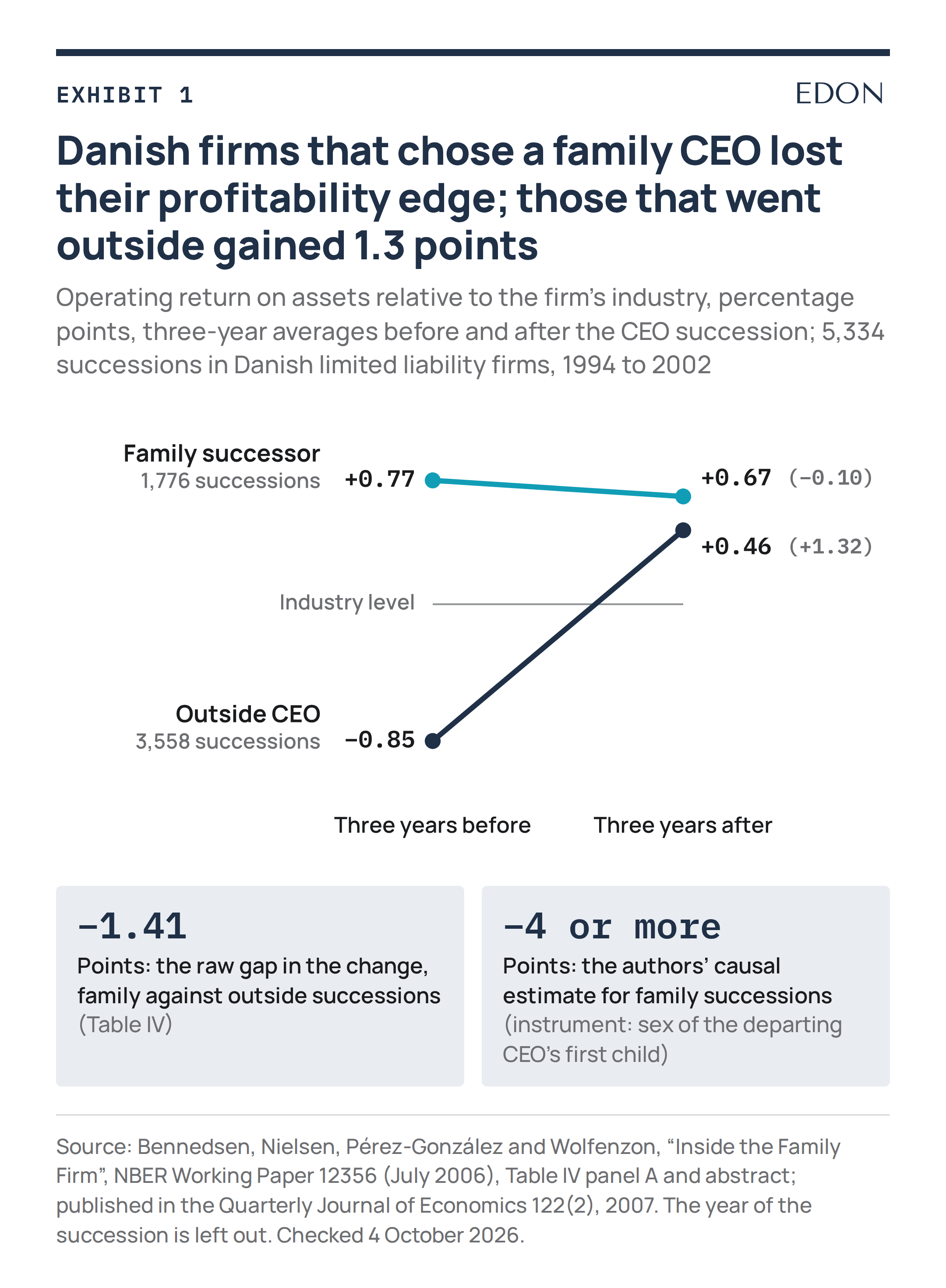
Exhibit 1. Danish firms that chose a family CEO lost their profitability edge; those that went outside gained 1.3 points. Operating return on assets relative to the firm's industry, three-year averages before and after 5,334 CEO successions in Danish limited liability firms, 1994 to 2002 (the year of the succession left out). Firms that chose a family CEO went from 0.77 to 0.67 percentage points above their industry; firms that hired an outsider went from 0.85 below to 0.46 above. The raw gap in the change is 1.41 points. The authors' causal estimate, which uses the sex of the departing CEO's first child as an instrument, puts the fall in profitability after a family succession at four percentage points or more. Source: Bennedsen, Nielsen, Pérez-González and Wolfenzon, "Inside the Family Firm", NBER Working Paper 12356 (July 2006), Table IV panel A and abstract; published in the Quarterly Journal of Economics 122(2), 2007. Checked 4 October 2026.
Studies in other countries mostly agree, with caveats (Exhibit 2). In the United States, Pérez-González (opens in a new tab) (American Economic Review, 2006) found that profitability and market value fell after a family CEO took over, mainly where the heir had not attended a selective university. In Italy, Cucculelli and Micucci (opens in a new tab) (Journal of Corporate Finance, 2008) found that keeping management in the family after the founder hurt performance, mostly in firms that had been outperforming and in competitive industries. France is the exception: among companies listed from 1994 to 2000, Sraer and Thesmar (opens in a new tab) (Journal of the European Economic Association, 2007) found that family firms largely outperformed widely held ones, whether the founder, an heir or a hired manager ran them.
Selection is the common thread in the penalty findings. A family that looks only at its own children chooses from a handful of people, while a search can consider many more. In Denmark the cost of that narrow choice was highest in fast-growing and skill-intensive industries, where the job asks most of the CEO.
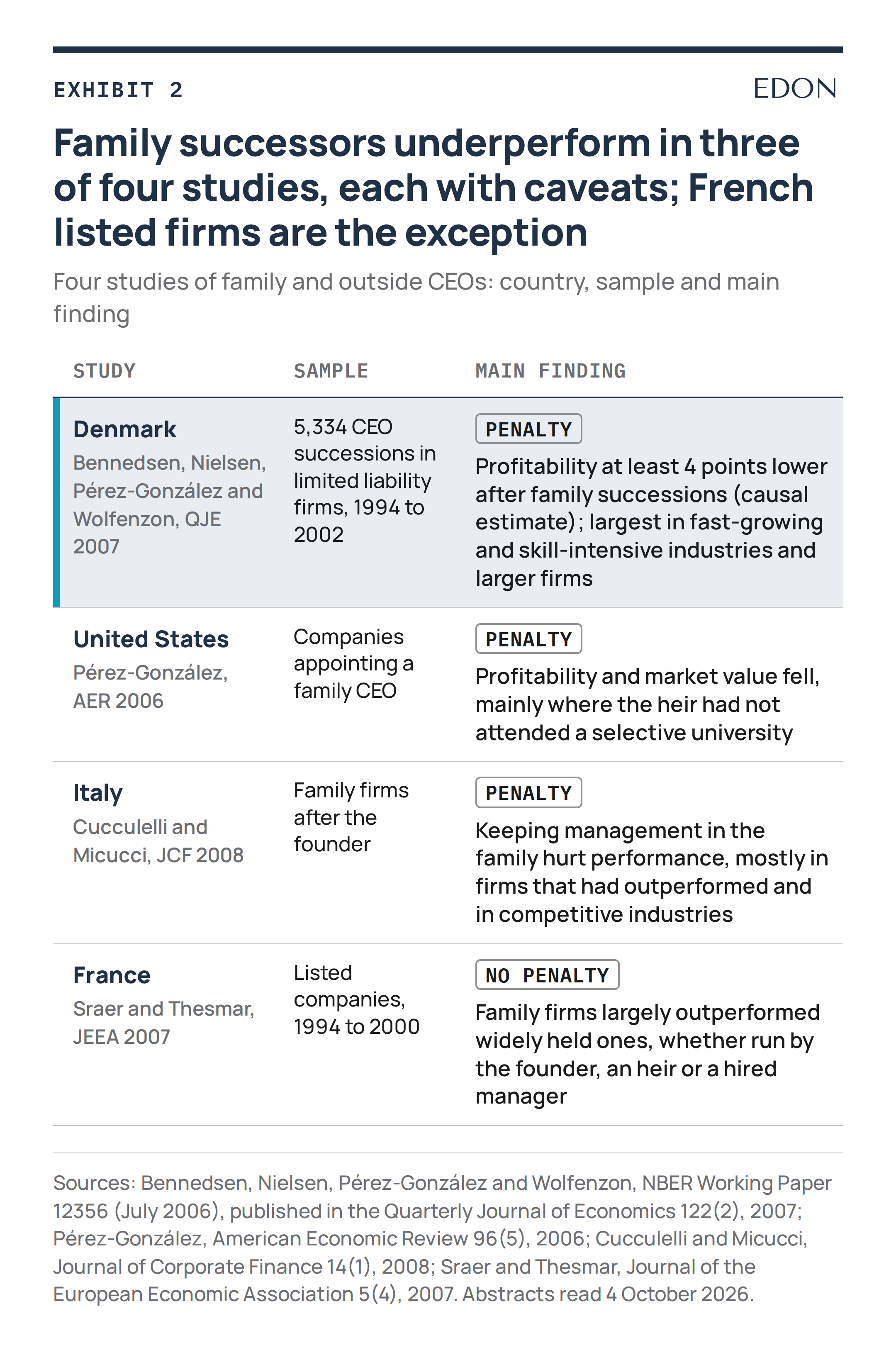
Exhibit 2. Family successors underperform in three of four studies, each with caveats; French listed firms are the exception. Four studies of family and outside CEOs. Denmark (Bennedsen, Nielsen, Pérez-González and Wolfenzon, QJE 2007): profitability at least 4 points lower after family successions, largest in fast-growing and skill-intensive industries and larger firms. United States (Pérez-González, AER 2006): profitability and market value fell, mainly where the heir had not attended a selective university. Italy (Cucculelli and Micucci, Journal of Corporate Finance 2008): keeping management in the family hurt performance, mostly in firms that had outperformed and in competitive industries. France (Sraer and Thesmar, JEEA 2007): family firms, whether run by the founder, an heir or a hired manager, largely outperformed widely held listed firms, 1994 to 2000. Sources: the four studies as named; abstracts read on IDEAS (RePEc) and the NBER working paper, 4 October 2026.
In a turnaround, more of the result rests on the CEO's own calls, and several of them land on the family. Those calls can mean closing the division the founder built or stopping a dividend the family relies on, and sometimes a cousin has to leave a senior job. An outsider makes those calls without the loyalties a family successor inherits. None of the studies isolates turnarounds, so applying their results here is a judgement.
The Italian study points the other way. If the family penalty falls mostly on firms that were outperforming, a company already in trouble has less of a lead to lose. That argues for testing every candidate, family included, against what this particular turnaround needs.
The three decisions are best taken in order, each by the people it belongs to (Exhibit 3).
Ownership comes first, because a CEO will struggle to fix a company whose owners disagree on whether to keep it. The owners agree who will own the company after the handover and what they want from it over the next five years: rebuild and keep it, grow it, or prepare a sale. In a turnaround they also agree how much new money or guarantee risk they will carry.
With that settled, the owners choose a board that can run the search and hold the CEO to account. For the turnaround years it helps to have at least one independent member who has been through a restructuring, and a stated role for the senior generation, as chair or as an ordinary member.
The board chooses the CEO last. It starts by writing a profile of what the role demands over the next two to three years, such as how much cash must be freed, which units to fix or sell, and which lenders the company cannot afford to lose. The profile test, as EDON calls it, measures the family candidate and outside candidates against that profile.
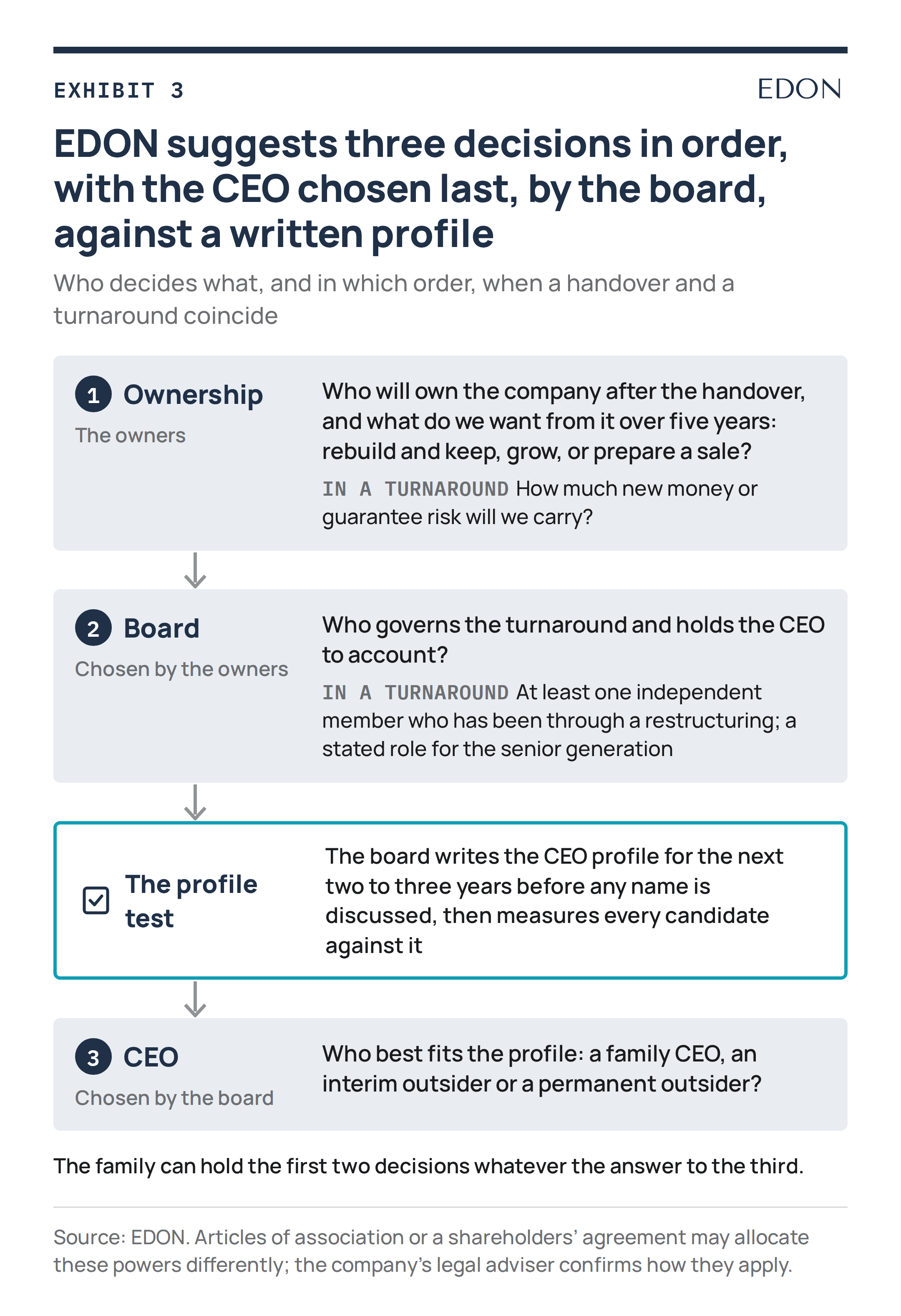
Exhibit 3. EDON suggests three decisions in order, with the CEO chosen last, by the board, against a written profile. Ownership first, decided by the owners (who will own the company and what they want from it over five years; in a turnaround, how much new money or guarantee risk they will carry). The board second, chosen by the owners (at least one independent member who has been through a restructuring; a stated role for the senior generation). Then the profile test: the board writes the CEO profile for the next two to three years before any name is discussed and measures every candidate against it. The CEO last, chosen by the board: a family CEO, an interim outsider or a permanent outsider. Source: EDON. Articles of association or a shareholders' agreement may allocate these powers differently; the company's legal adviser confirms how they apply.
The answer turns mainly on two things: how long the crisis gives the board, and whether a family candidate can beat outside candidates in the profile test. Exhibit 4 sets out the conditions for each option, which are judgements built on the evidence above.
An interim CEO from outside buys time when the bank's covenant test is weeks away or the largest customer has just left, and a full search would finish too late. It can also hold the role for a family successor who is promising but not ready. The risk is that it drifts, so the mandate, the end date and the date of the permanent decision are best agreed before the interim starts.
A family can bring in a permanent outsider and keep control through ownership and its board seats, where the outsider's targets are set. In the French study, family firms run by hired managers outperformed widely held companies too.
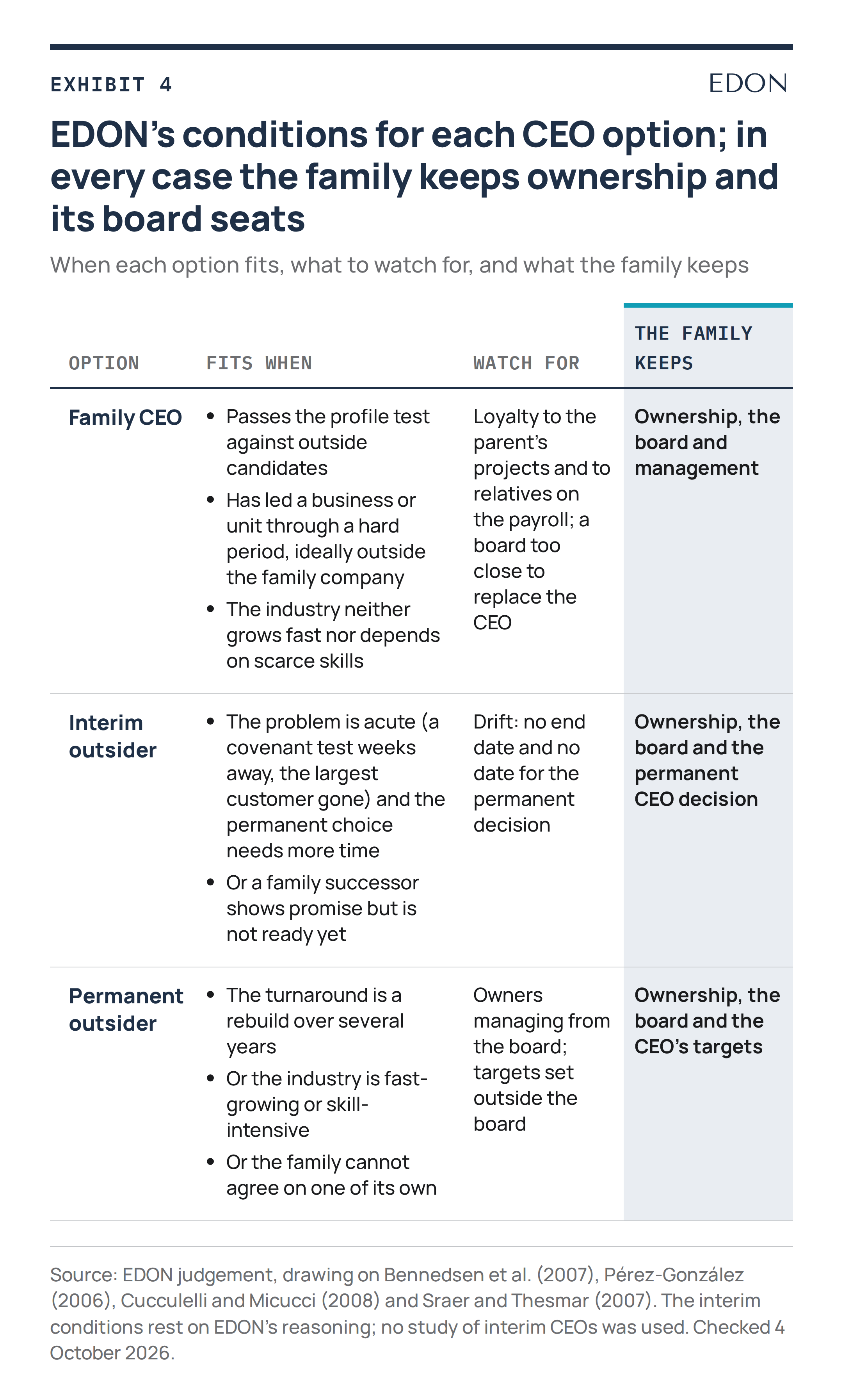
Exhibit 4. EDON's conditions for each CEO option; in every case the family keeps ownership and its board seats. When a family CEO, an interim outsider or a permanent outsider fits, what to watch for with each, and what the family keeps. An interim outsider fits when the problem is acute (a covenant test weeks away, the largest customer gone) and the permanent choice needs more time. Source: EDON judgement, drawing on Bennedsen et al. (2007), Pérez-González (2006), Cucculelli and Micucci (2008) and Sraer and Thesmar (2007). The interim conditions rest on EDON's reasoning; no study of interim CEOs was used. Checked 4 October 2026.
It can be wrong for a small company whose value sits in the owner's own customer relationships and skills. An outside CEO may cost more than the business can carry, and the Danish penalty was largest in relatively large firms. In that case the family CEO can stay, with an experienced board member or adviser added. Separation also adds little when the family candidate is plainly the strongest person available. And it comes too early while the owners disagree on keeping the company, or when a sale or a formal restructuring is the realistic path; those questions need answers before any CEO search starts.
EDON suggests starting with a meeting of the owners, before any name is discussed, to agree what the family wants from the company over the next five years and who sits on the board through the turnaround. The board then writes the CEO profile and runs the profile test, family included. If cash is the immediate problem, EDON's Turnaround Toolkit starts with cash and a 13-week cash forecast, and the steps after that are covered in a separate article on turning around a struggling company.
EDON is a strategy and transformation firm based in Finland. It works with owners and boards on which parts of a portfolio to grow, fix or exit, and on making the changes work. The choice of CEO stays with your board, and legal questions with your adviser.
If this is on your desk right now, EDON offers a free 30-minute sparring session, with no obligation.
Related


Resources for this capability
Six stages, from an honest baseline and an emergency plan to the reviews that keep the handover standing. Free to read.
