
Strategy · M&A, Partnerships and Market Entry
If this is on your desk right now, EDON offers a free 30-minute sparring session, with no obligation.
Book 30 minutes (opens in a new tab)
An owner strategy is the owners' shared answer to why they own the company and where it should go. EDON suggests that owners of a Finnish family or owner-led firm agree it on one page before the next strategy round or handover, because many rounds stall on an unsettled owner question: growth or dividends, how much risk, keep or sell.
The Finnish Family Firms Association (opens in a new tab) (Perheyritysten liitto) defines the owner strategy, omistajastrategia in Finnish, as the owners' common view of why the company is owned and in which direction they want it developed. It states plainly that this is not the same thing as the business strategy. The owner strategy sets what the owners want; the company strategy shows how the business will get there. A clear owner strategy, in the association's words, works as a guideline for the board and management (Exhibit 1).
The association builds it around four questions: why do we own, what do we want to own, how do we own, and who may own. In younger companies the same choices often sit, less visibly, in a shareholder agreement and a business plan, as KPMG Finland (opens in a new tab) notes.
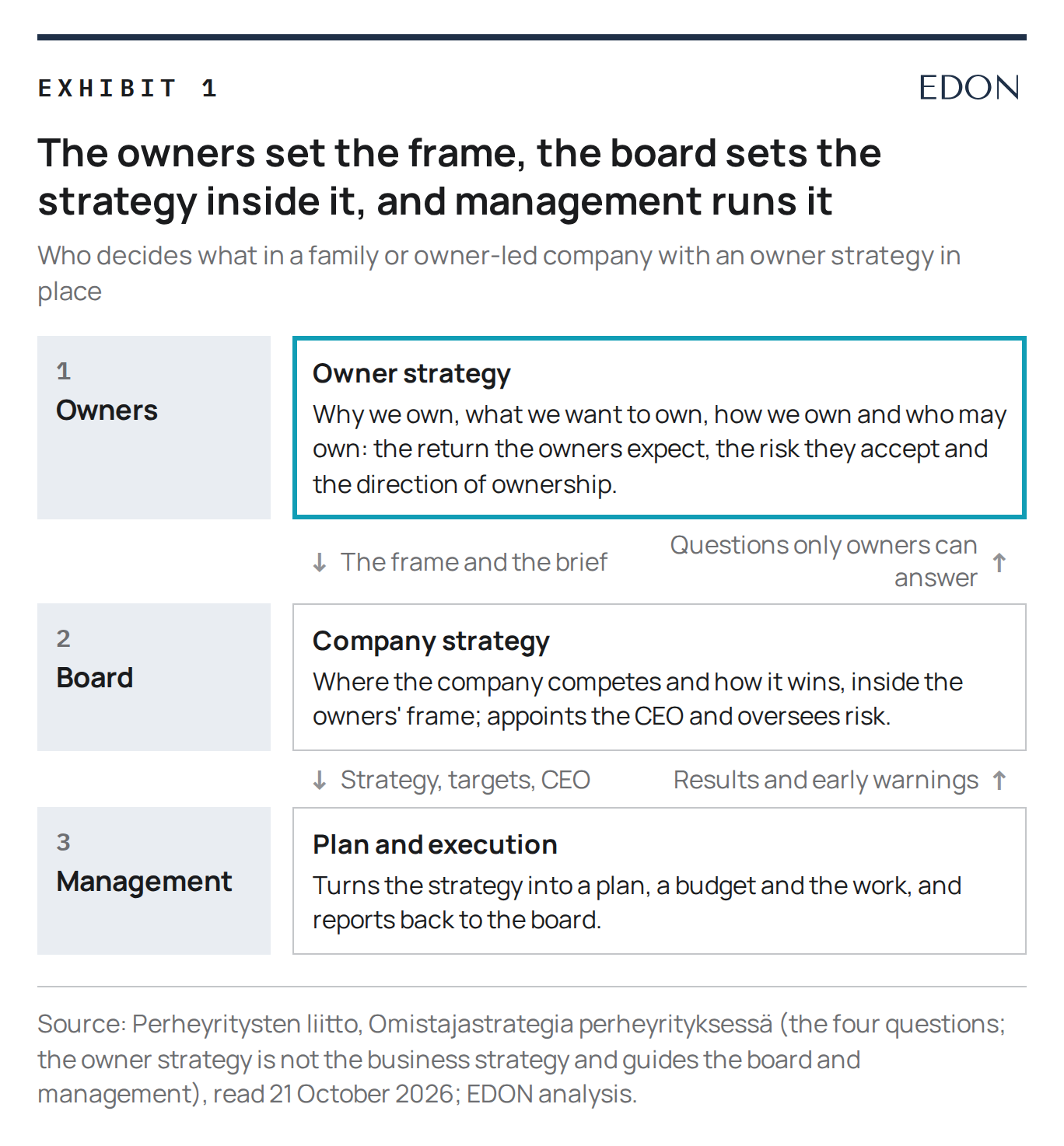
Exhibit 1. The owners set the frame, the board sets the strategy inside it, and management runs it. Source: Perheyritysten liitto, Omistajastrategia perheyrityksessä (read 21 October 2026); EDON analysis.
Family firms carry much of Finland's economy. An Aalto University study (opens in a new tab) published in February 2026 counts them as 73% of employer companies, with 42% of employment and 31% of turnover, yet only about 135,000 people own shares in them. With so few owners, a handful of views decide what the company may do.
Many of these owners face an ownership decision soon. In the ownership change barometer (opens in a new tab) surveyed in September 2024 and published in 2025, 36% of Finnish family firms planned a generational handover, 41% a sale and 18% a closure (Exhibit 2). A board drafting a five-year plan needs to know which of these the owners intend, and when.
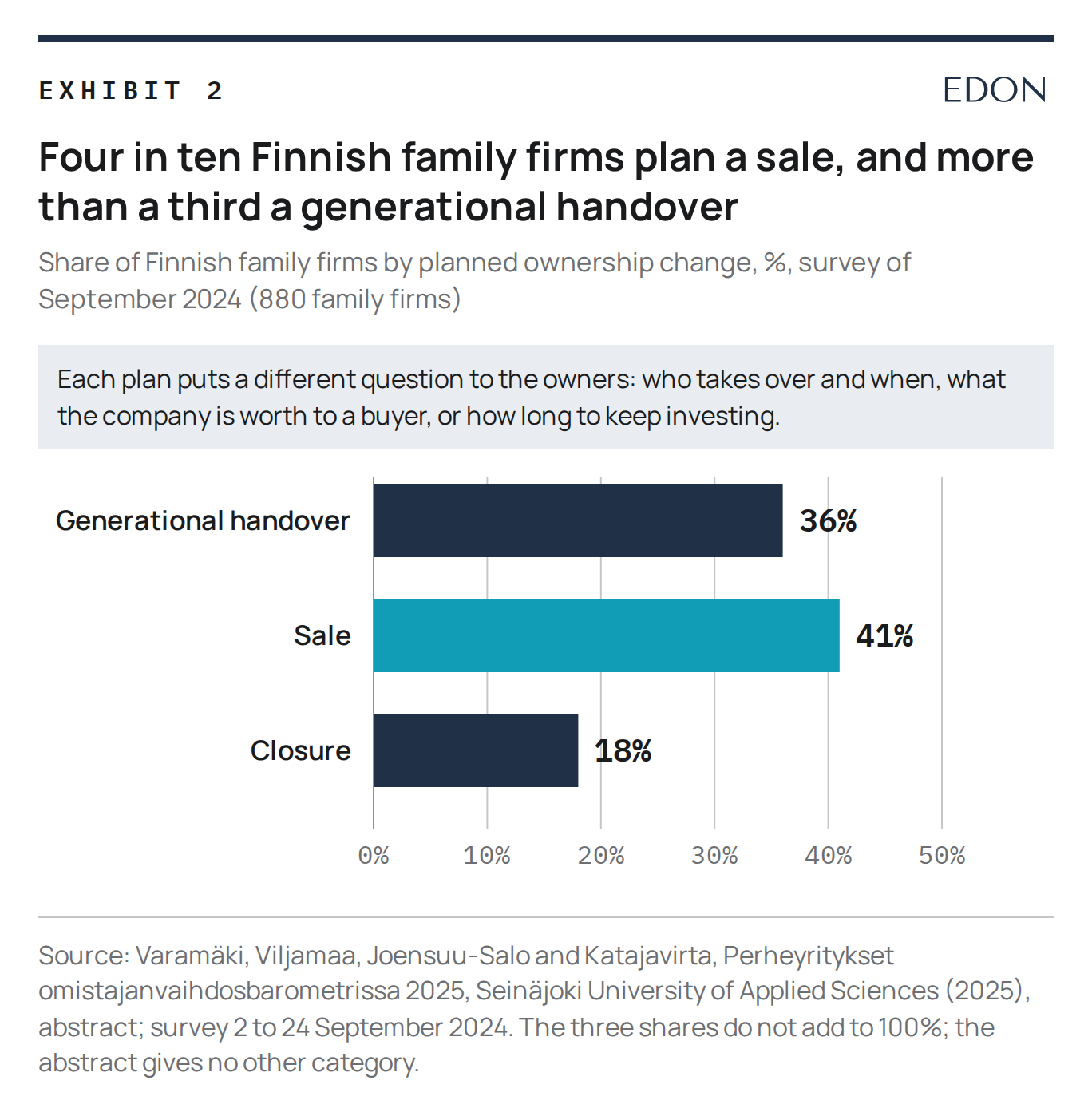
Exhibit 2. Four in ten Finnish family firms plan a sale, and more than a third a generational handover. Source: Varamäki, Viljamaa, Joensuu-Salo and Katajavirta, Perheyritykset omistajanvaihdosbarometrissa 2025, Seinäjoki University of Applied Sciences (2025), abstract; survey 2 to 24 September 2024. Data file: ART-032_exhibit2-data_v2.csv.
A stalled round often runs like this. Management brings growth options; one owner wants to reinvest, another needs the dividend; the board debates the options when the real disagreement is about the owners' goals. The round ends with a plan that tries to keep everyone content and commits to little.
The Aalto study also shows how owner choices already shape these companies. Family firms use less debt yet invest more than other companies, and they are on average more profitable and more solvent. That is a risk preference showing up in the balance sheet. Written down, it becomes a boundary the board can plan against.
EDON suggests turning the association's four questions into four decisions, each stated plainly enough that the board can test an option against it:
Exhibit 3 shows what each answer can rule out.
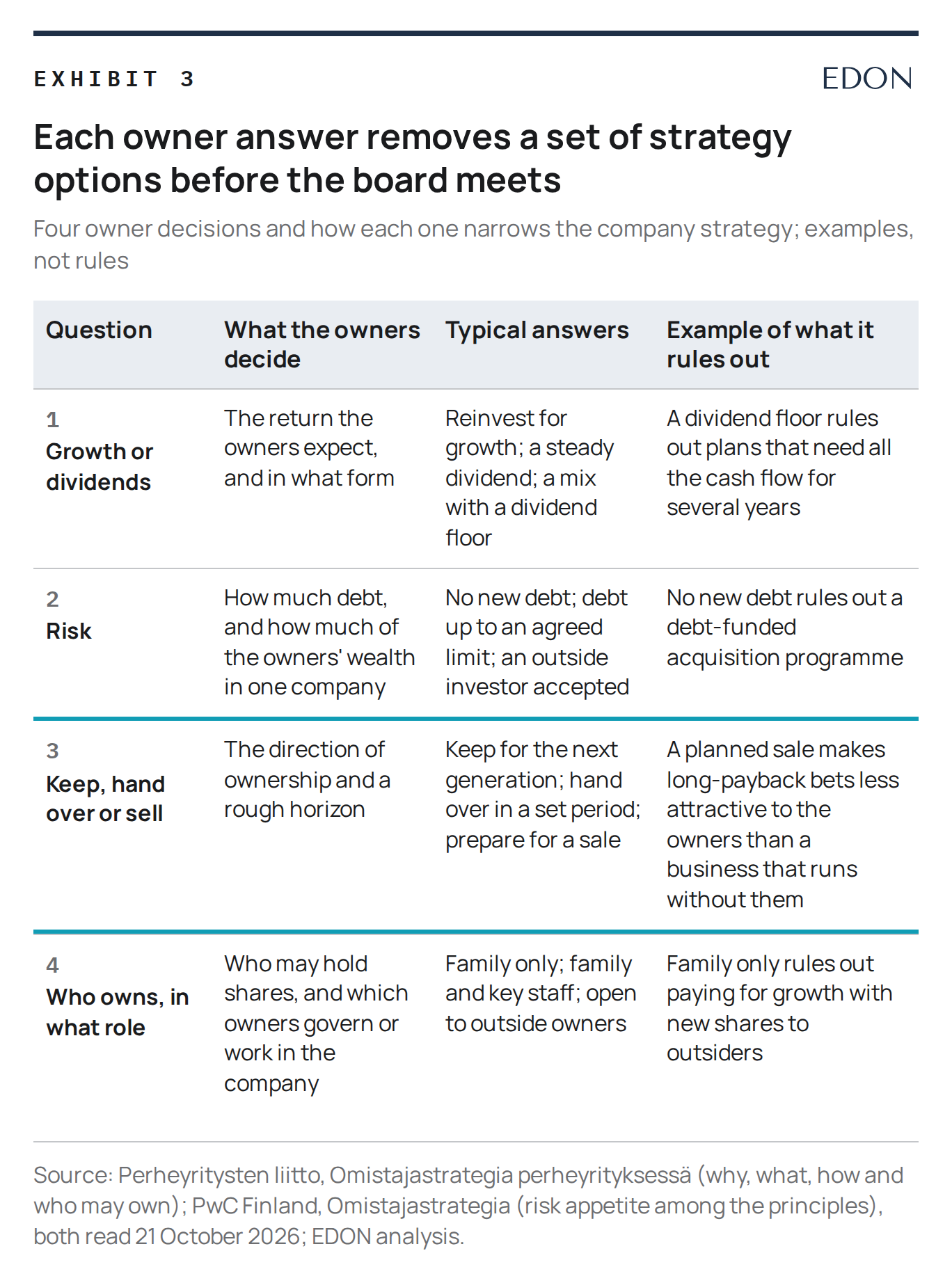
Exhibit 3. Each owner answer removes a set of strategy options before the board meets. Source: Perheyritysten liitto, Omistajastrategia perheyrityksessä (the four questions); PwC Finland, Omistajastrategia (risk appetite among the principles), both read 21 October 2026; EDON analysis. Examples, not rules.
One page is enough. Values, family rules and the history of the company have their place in a family charter. The owner strategy is the short document the board takes into the strategy round (Exhibit 4).
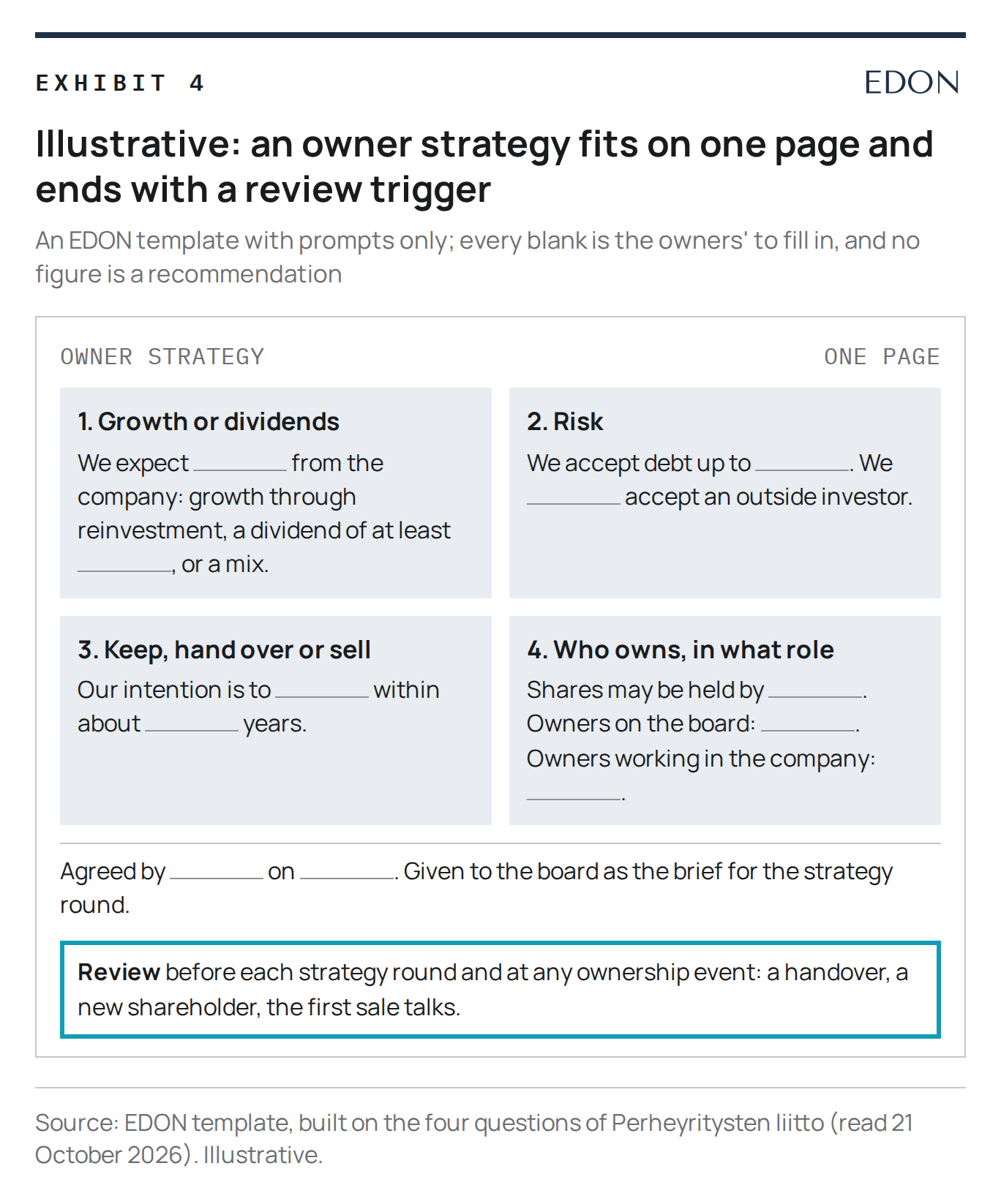
Exhibit 4. Illustrative: an owner strategy fits on one page and ends with a review trigger. Source: EDON template, built on the four questions of Perheyritysten liitto (read 21 October 2026). Illustrative.
It changes what the board is asked to decide. Without it, the board weighs every option and then discovers which ones the owners will not fund. With it, the board receives a brief, and options outside the brief fall away before management spends weeks on them. The owner strategy is the brief; the company strategy is the answer to it.
Take three cases. If the owners want a steady dividend and no new debt, an acquisition-led plan is off the table, and the round turns to organic growth and margin. If the owners intend to hand the company to the next generation, the strategy has to be one the successor can run, which shapes the choice of CEO and board (our article on family business succession in a turnaround covers that step). If they plan to sell within a few years, investments with a long payback matter less to them than a business that runs well without them.
The owners write it; the board and the CEO receive it. The Family Firms Association names open discussion and the participation of as many owners as possible as the factors that make it work, and calls it a document to update as circumstances change. KPMG Finland describes it as evolving with the company and its owners.
EDON suggests reviewing it at every ownership event (a handover, a new shareholder, the first sale talks) and before each strategy round. A chair can convene the discussion. In larger owner families, an independent facilitator often helps, so that the strongest voice in the room does not write the page alone. If the owners want a neutral sparring partner before they meet, EDON offers a free 30-minute sparring session (opens in a new tab), with no obligation.
A full process is too much where one owner holds all the shares and runs the company: the strategy round already reflects one person's goals, and a few written lines are enough. It is too late where a sale is signed and closing; the deal terms then decide. And it will not hold where owners are in open dispute. There, the disagreement needs a mediated conversation, or legal advice on the shareholder agreement, before any page can be agreed. This article is not legal or tax advice: binding rules between owners belong in a shareholder agreement drafted with a lawyer.
Hold one owners' meeting before the round starts, agree the four answers, and give the board the page. EDON, a strategy and transformation firm based in Finland, works with owners and boards of family and owner-led companies on the strategy that follows from those choices (see our Strategy work).
If this is on your desk right now, EDON offers a free 30-minute sparring session, with no obligation.
Related


Resources for this capability
Six stages, from an honest baseline and an emergency plan to the reviews that keep the handover standing. Free to read.
