
Interim management for companies in change: who takes the seat, and what the board gets in 90 days
Executive summary
- An interim executive fits a company in a turnaround, an M&A deal, a sudden departure in the leadership team or a new market.
- We take the interim chief strategy or chief operating officer's seat and, in smaller companies, the CEO's or CFO's, each with a short, specific mission.
- The first 30 days stop the obvious bleeding and build trust; the board gets something from us at day 30, 60 and 90.
- We can start within two weeks of agreeing the mandate; most assignments run six to twelve months, with the handover planned from the first month.
If this is on your desk right now, EDON offers a free 30-minute sparring session, with no obligation.
Book 30 minutes (opens in a new tab)
On this page
This page is for owners, boards and investors of mid-sized and family-owned companies going through a change, such as a turnaround, an M&A deal or the sudden departure of a leadership team member. Our answer: put an interim executive in the seat with a written mandate and a short, specific mission, and plan the handover from the first month.
When do owners and boards call us in?
When a change has started and someone has to lead it from inside the company:
- A turnaround, when the business is losing money and needs both a plan and someone to carry it out.
- An M&A deal, when two companies have to work as one after an acquisition.
- A sudden departure, when a leadership team member has been dismissed or has left and the company cannot wait for a search to finish.
- A new market, when someone has to build and run the business there.
If one of these is your situation, a free 30-minute sparring session with EDON (opens in a new tab), with no obligation, is enough to test the seat, the mandate and the fit.
Which interim seats do we take?
Any interim position in the leadership team whose job is to bring order to a chaotic situation in a short time, with a specific mission. Our focus is the change process. We step in as interim chief strategy officer (CSO) or chief operating officer (COO) and, in smaller companies going through such a change, as interim CEO or CFO. We also take the roles of general manager of a business; country or branch manager, when a company enters a new market; head of strategy or corporate development; and transformation lead.
What happens in the first 90 days?
The board gets something from us at day 30, day 60 and day 90 (Exhibit 1).
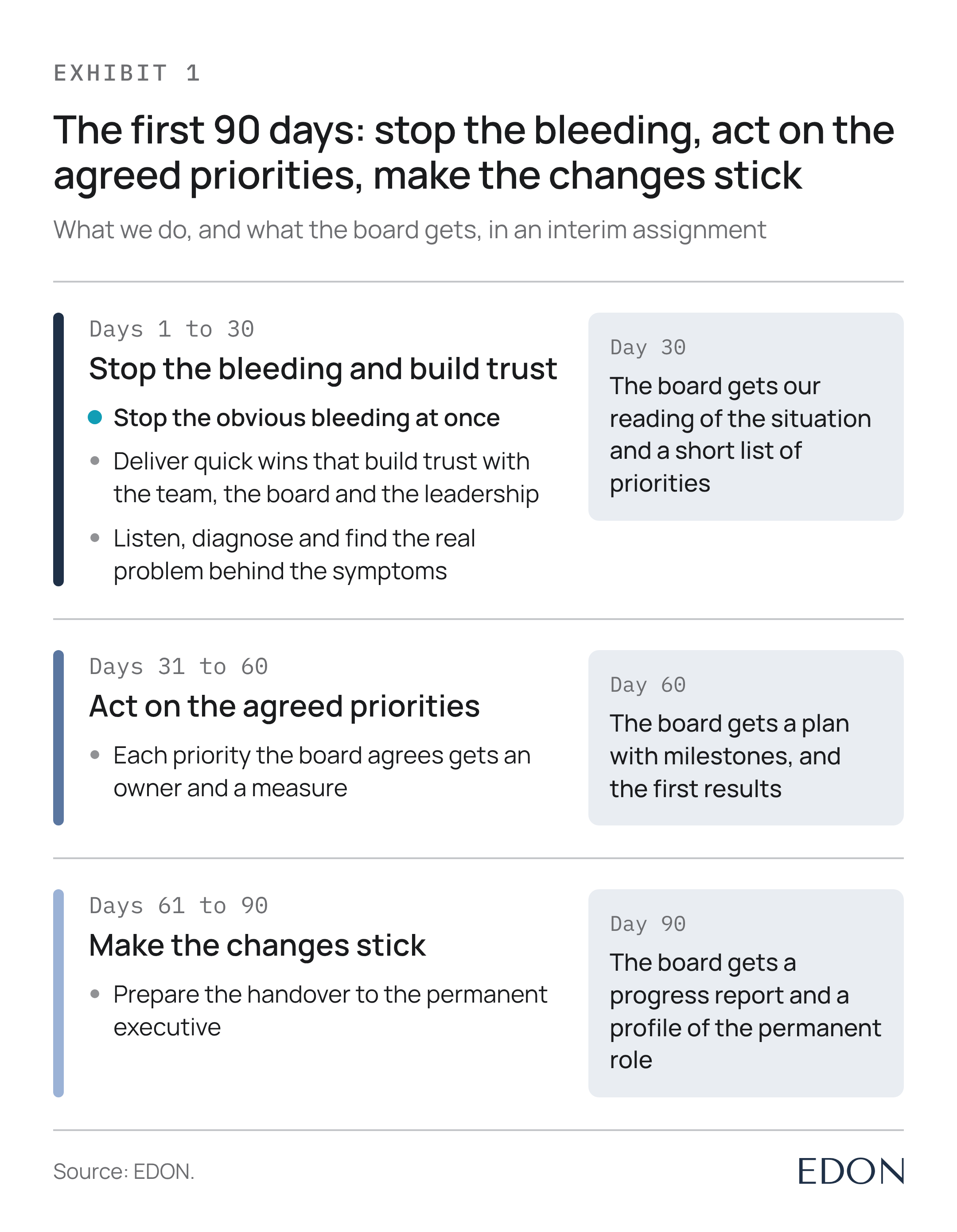
- Days 1 to 30. Stop the obvious bleeding at once, and deliver quick wins that build trust with the team, the board and the leadership. At the same time, listen and diagnose: meet the team, the main customers and the people who do the work, and find the real problem behind the symptoms. It is not always the one the board expects. The board gets our reading of the situation and a short list of priorities.
- Days 31 to 60. Act on the priorities the board agrees, each with an owner and a measure. The board gets a plan with milestones and the first results.
- Days 61 to 90. Make the changes stick and prepare the handover. The board gets a progress report and a profile of the permanent role.

Exhibit 1. The first 90 days: stop the bleeding, act on the agreed priorities, make the changes stick.
What must the owner or board have ready on day one?
- A written mandate, saying what we are there to fix, which decisions we make alone and which go to the board.
- One named board member as our contact.
- Access to the numbers: management accounts, budget and main contracts.
- An announcement to the team before we arrive, saying why we are there and for how long.
How do we hand over to the permanent executive?
We plan the handover from the first month. We help the board write the role profile and can join the final interviews. When the permanent executive starts, we overlap for a few weeks: we hand over the plan, the open decisions and the key relationships, then step back.
How is EDON different from an interim agency or a recruiter?
A recruiter sends candidates; an interim agency places someone from its list. Both usually step back once the contract is signed. With EDON, the person who diagnoses the problem also runs the change, using our methods and tools. When the permanent hire comes, we can help define the role and judge the candidates, because by then we have done the job ourselves.
Interim leadership is part of our transformation and performance work.
What does this look like in practice?
Two examples from Kave Asad's experience, before EDON:
- A turnaround from the general manager's seat. An oil and gas engineering, procurement and construction (EPC) contractor's office was losing money. Kave was first brought in for a short visit to find the quickest way to close it. He came back with a turnaround plan instead and was appointed general manager to carry it out, also running the company during the CEO's regular absences. The turnaround covered operations, the cost base, the organisation and new business. Within a year, net margin went from minus 3 per cent to plus 9 per cent, and the team grew from 15 to 126 people to take on larger projects.
- A crisis in global sourcing. At a petrochemical producer where he worked as an internal strategy consultant, Kave was also appointed interim head of global sourcing after a crisis, with a specific mission to overcome it. He led a sourcing team of 15. Purchasing costs fell by 20 per cent, and process time improved by 60 per cent.
When is an interim executive the wrong answer?
An interim executive is the wrong answer when the board wants a caretaker to hold the seat, with no mandate to change anything. We turn those seats down.
It is also the wrong answer when the board is not ready to hand over the authority that comes with the seat. We take the seat and make the decisions the mandate gives us.
Questions boards ask
How fast can you start? Within two weeks of agreeing the mandate.
How long does an assignment last? Most run six to twelve months.
Who sits in the seat? Kave Asad, or another interim executive that EDON provides.
Start with the problem, not the proposal.
If this is on your desk right now, EDON offers a free 30-minute sparring session, with no obligation.
Resources for this capability
The Turnaround Toolkit
Four stages, from the first 30 days of cash control to the board’s role once the crisis has passed. Free to read.


