
Strategy · M&A, Partnerships and Market Entry
If this is on your desk right now, EDON offers a free 30-minute sparring session, with no obligation.
Book 30 minutes (opens in a new tab)
For a Qatari investor deciding how to invest in Finland, picking a route means picking an approval path. A commitment to a Finnish venture fund usually leaves the approvals to the fund. A stake in a defence company needs government approval before closing. The planned act would extend that to dual-use technology and large new data centre and energy projects.
The question became practical in Doha on 29 September, when Qatar Chamber hosted a government-led Finnish trade delegation. Its members included Nokia, the defence group Patria, the space company ReOrbit and Tesi (Finnish Industry Investment), the state-owned investor. The talks were exploratory; no agreements were announced (opens in a new tab). Tesi used the visit to offer Qatari business leaders three ways in (opens in a new tab): venture funds with Tesi as anchor investor, direct stakes in growth-stage companies, and industrial-scale projects such as data centres, hydrogen, batteries and sustainable aviation fuel.
Several sectors on show, from defence to data centres and energy, sit inside Finland's screening of foreign investment, or will under the planned act.
A fund suits an investor that wants exposure without control, a direct stake one that wants a say in one company, and an industrial project one with an industrial partner (Exhibit 1).
A fund commitment buys a share of a portfolio the manager picks, with no say over which companies get the money. Finnish funds raise most of their money at home. Finnish investors supplied 75% of the record EUR 678 million they raised in 2025, according to the Finnish Venture Capital Association (opens in a new tab). Qatar Investment Authority already invests this way, through a fund-of-funds programme raised to USD 3 billion (opens in a new tab) in February 2026 that backs international venture managers such as Europe's Speedinvest.
A direct stake buys a minority share in one company, next to a lead investor. Finnish rounds already run on foreign money. Foreign venture and growth investors put EUR 494 million into Finnish startups in 2025, against EUR 270 million from Finnish ones (Exhibit 2). Tesi joins such rounds as a minority investor and, as a principle, does not lead; its growth investments usually range from EUR 10 to 50 million (opens in a new tab).
An industrial project buys equity in one asset, such as a data centre or a battery plant. Tesi can act as the domestic anchor investor, but every project it backs needs a strong industrial lead investor, so a financial investor without an industrial partner has to bring or join one.
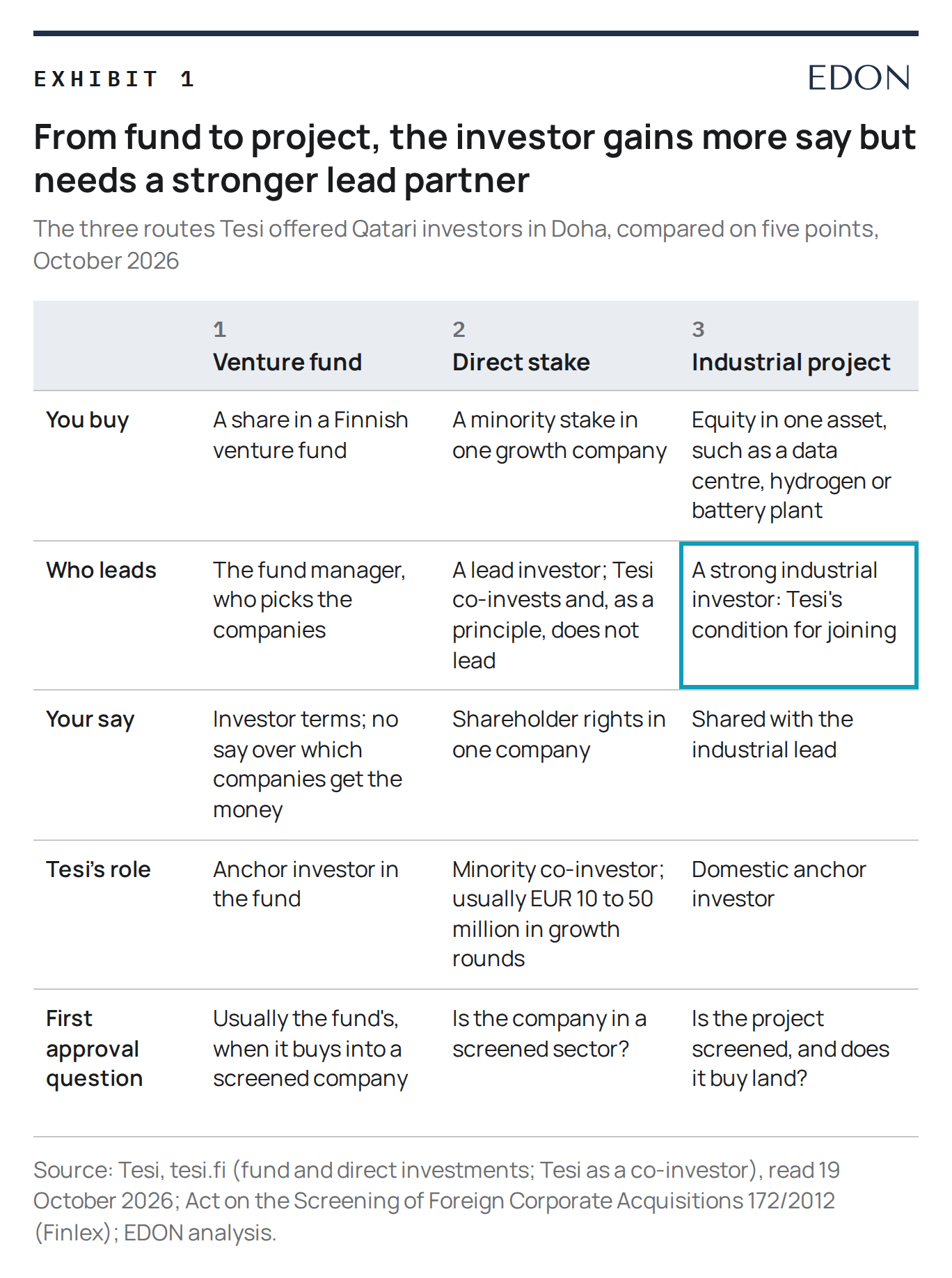
Exhibit 1. From fund to project, the investor gains more say but needs a stronger lead partner. The three routes into Finland compared on five points, October 2026. Source: Tesi, tesi.fi (fund and direct investments; Tesi as a co-investor), read 19 October 2026; Act on the Screening of Foreign Corporate Acquisitions 172/2012 (Finlex); EDON analysis.
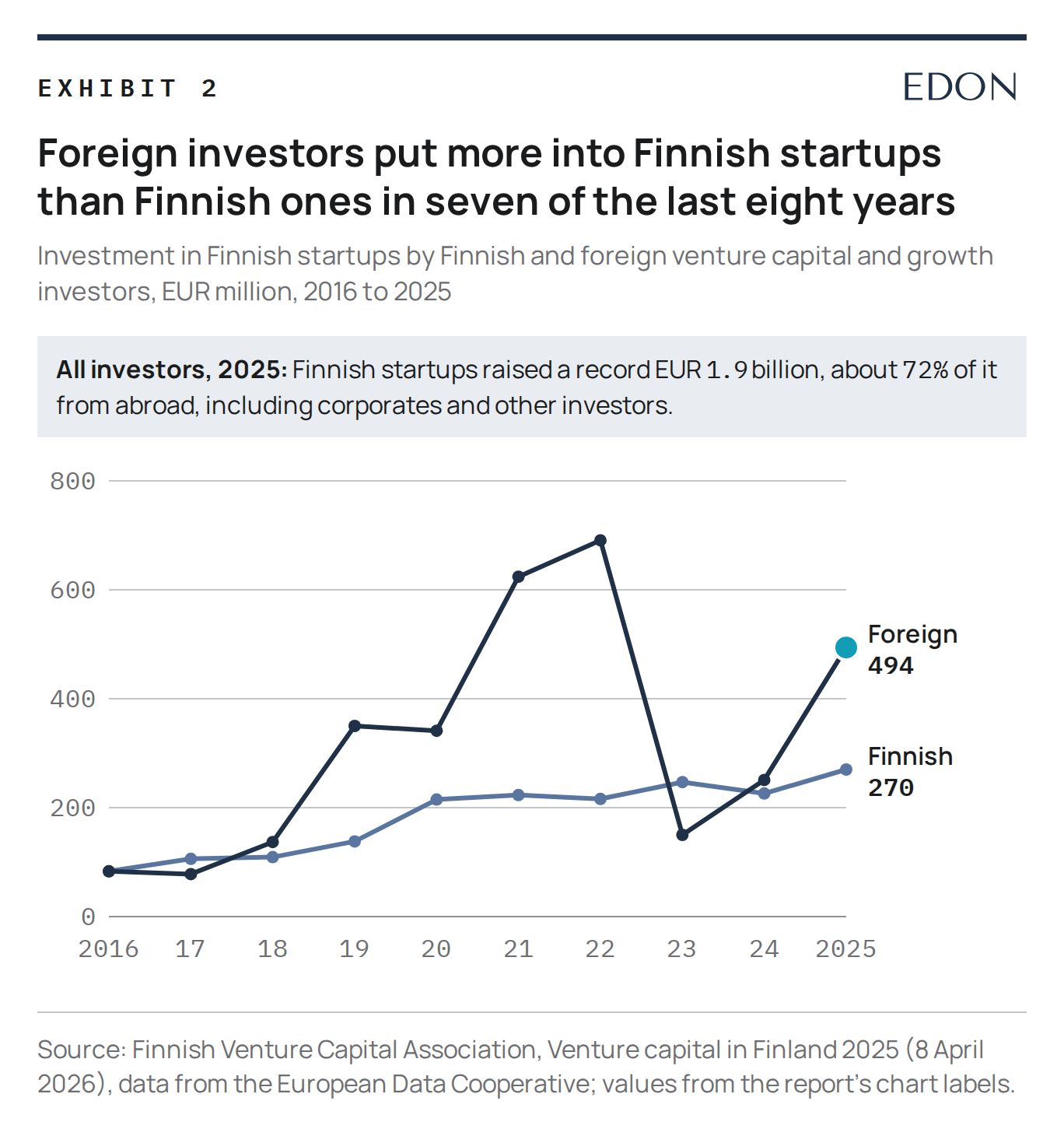
Exhibit 2. Foreign investors put more into Finnish startups than Finnish ones in seven of the last eight years. Investment in Finnish startups by Finnish and foreign venture capital and growth investors, EUR million, 2016 to 2025. Source: Finnish Venture Capital Association, Venture capital in Finland 2025 (8 April 2026), data from the European Data Cooperative.
Finland screens foreign direct investment under the Act on the Screening of Foreign Corporate Acquisitions (opens in a new tab) of 2012, which the Ministry of Economic Affairs and Employment administers. A Qatari buyer counts as a foreign owner, even through a European holding company: a company in the EU or EFTA in which investors from outside those countries hold a tenth of the votes, or similar influence, counts as foreign too.
In a defence company, or a company supplying critical products or services for the authorities' security duties, the foreign owner must apply for confirmation before buying a tenth, a third or half of the votes. For other companies critical to society, notification is voluntary. The Ministry confirms a deal unless it could endanger a national interest the act protects, and only the Government, in plenary session, can refuse one.
Land is a separate gate. Foreigners can buy property in Finland, but buyers from outside the EU and EEA need a permit from the Ministry of Defence under the Act on Transfers of Real Estate Requiring Special Permission (opens in a new tab). A project that buys its own site may need one even when no company changes hands.
For a fund commitment, the approvals usually sit with the fund, which files only if it counts as foreign itself by the same test. A large anchor commitment with special rights is worth a lawyer's look before signing (Exhibit 3).
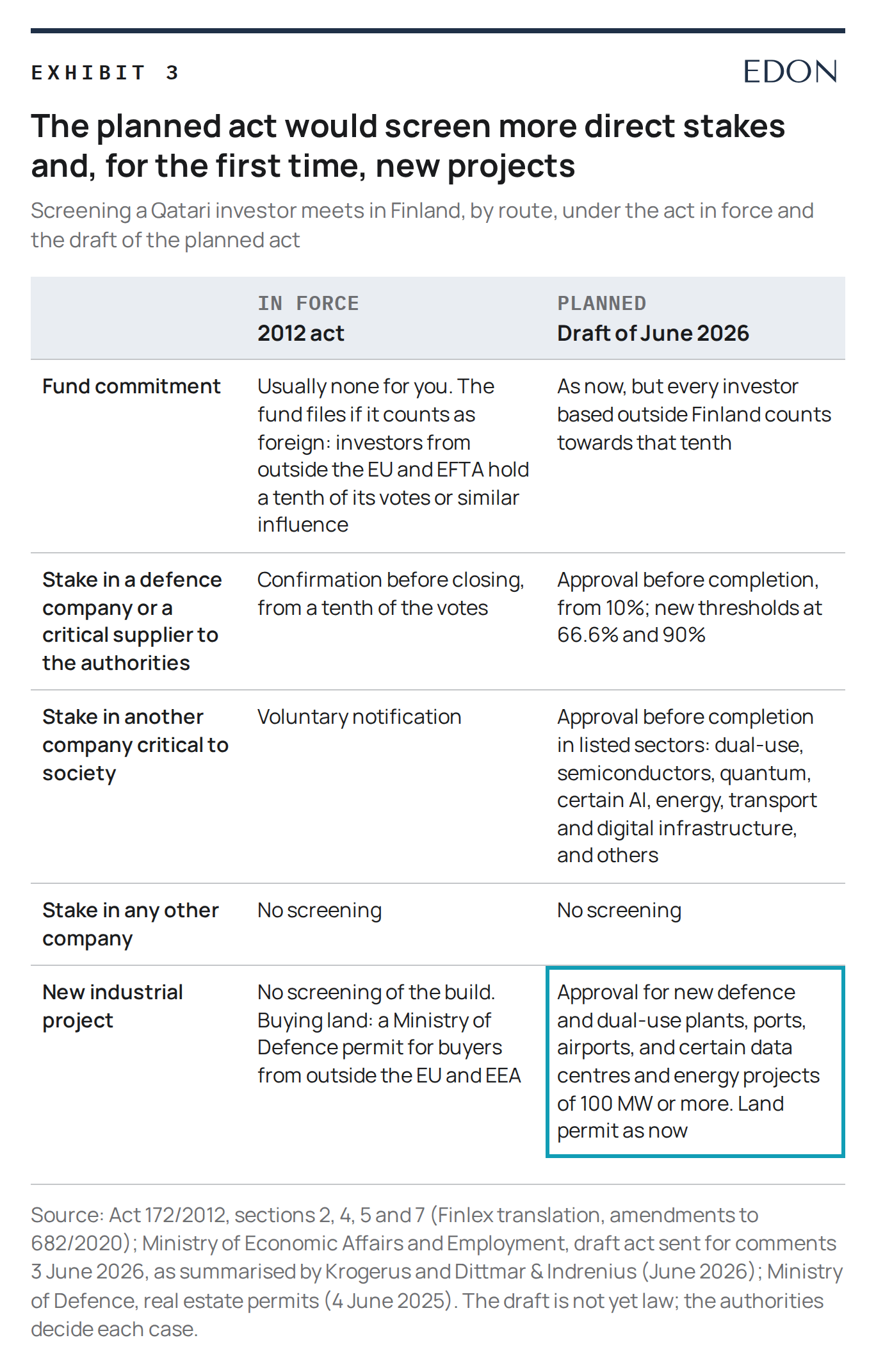
Exhibit 3. The planned act would screen more direct stakes and, for the first time, new projects. Screening a Qatari investor meets in Finland, by route, under the act in force and the draft of the planned act. Source: Act 172/2012, sections 2, 4, 5 and 7 (Finlex translation, amendments to 682/2020); Ministry of Economic Affairs and Employment, draft act sent for comments 3 June 2026, as summarised by Krogerus and Dittmar & Indrenius (June 2026); Ministry of Defence, real estate permits (4 June 2025). The draft is not yet law; the authorities decide each case.
The Ministry sent a draft of a new act (opens in a new tab) out for comments on 3 June 2026. It would replace the 2012 act. The government planned to put the bill to Parliament in the autumn, for entry into force in spring 2027 (opens in a new tab). Until Parliament passes it, the 2012 act applies and the details can change. As drafted, the new act would:
Space is not named in the draft; a space company would be covered if its products count as export-controlled dual-use items, which the authority decides.
Under either law, the hardest cases have no fixed end date: the 2012 act sets no deadline for a mandatory application, and the draft sets none for the second phase (Exhibit 4).
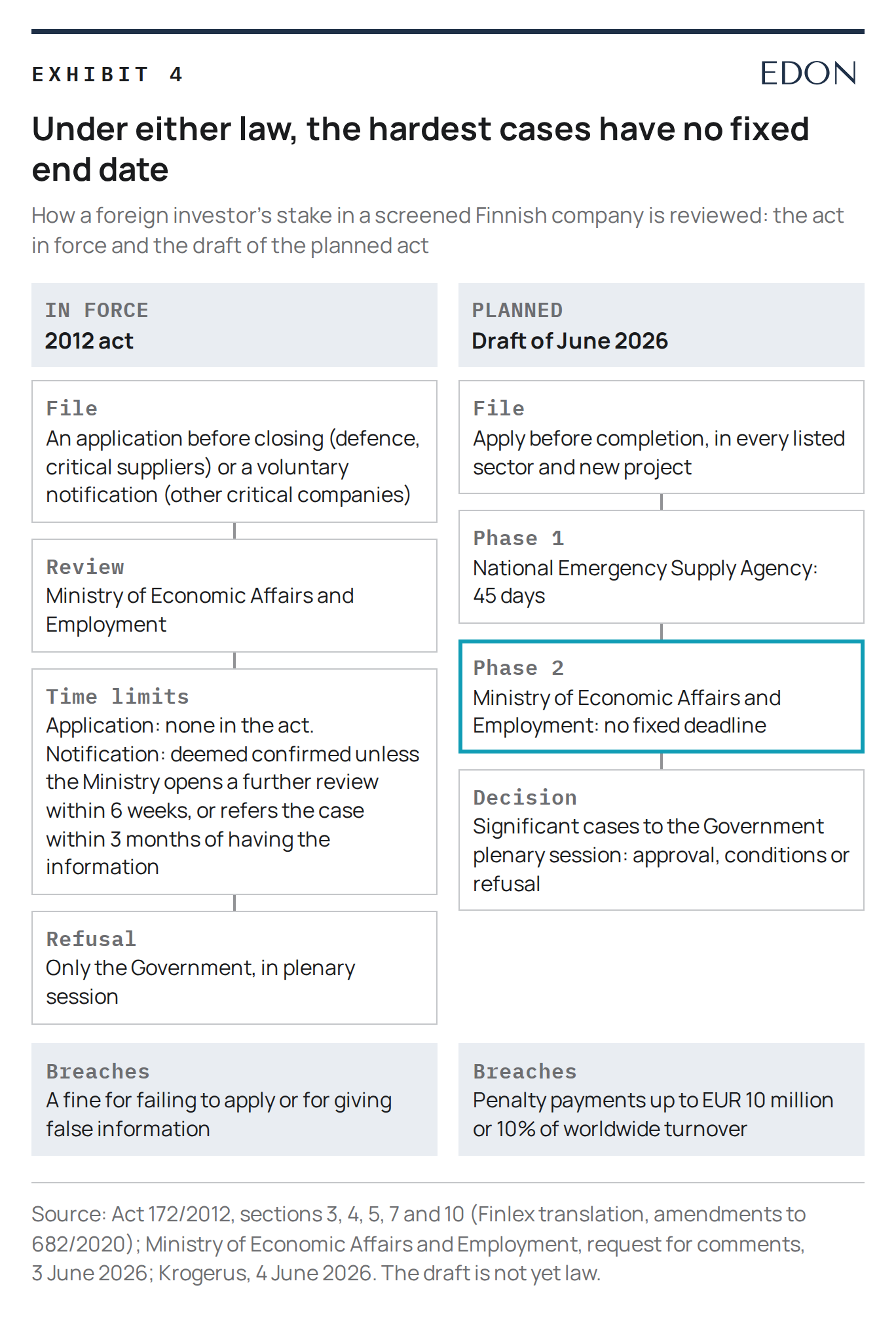
Exhibit 4. Under either law, the hardest cases have no fixed end date. How a foreign investor's stake in a screened Finnish company is reviewed, under the act in force and the draft of the planned act. Source: Act 172/2012, sections 3, 4, 5, 7 and 10 (Finlex translation, amendments to 682/2020); Ministry of Economic Affairs and Employment, request for comments, 3 June 2026; Krogerus, 4 June 2026. The draft is not yet law.
Two treaty questions come up early. Finland and Qatar have an agreement on the promotion and protection of investments (opens in a new tab), in force since 2003, but no tax treaty; Qatar is not on Finland's published list (opens in a new tab). Tax on dividends and exit gains then turns on domestic rules and the structure, a question for a tax adviser. Finland also plans to change its corporate tax from 2027, and EDON's piece on the planned change sets out what to time.
On the official figures, Finland is no outlier: Qatari direct investment barely registers anywhere in the region. Eurostat (opens in a new tab) put Qatar's direct investment in the EU at EUR 26.4 billion at the end of 2024. The largest published EU figures are Luxembourg (EUR 9.3 billion), the Netherlands (5.0 billion), Spain (4.5 billion) and France (3.0 billion), though money routed through a holding company counts where that company sits. Every Nordic and Baltic figure was EUR 3 million or less (Exhibit 5).
Only stakes of 10% or more count, so smaller stakes and fund commitments do not show. Sweden, at zero, shows the gap: in 2007 Qatar Holding bought 9.98% of OMX (opens in a new tab), then owner of most Nordic and Baltic exchanges, and in 2026 the Qatar Investment Authority joined a consortium with EQT (opens in a new tab), the Swedish buyout firm, to bid for a Volkswagen unit. Direct Qatari stakes remain rare.
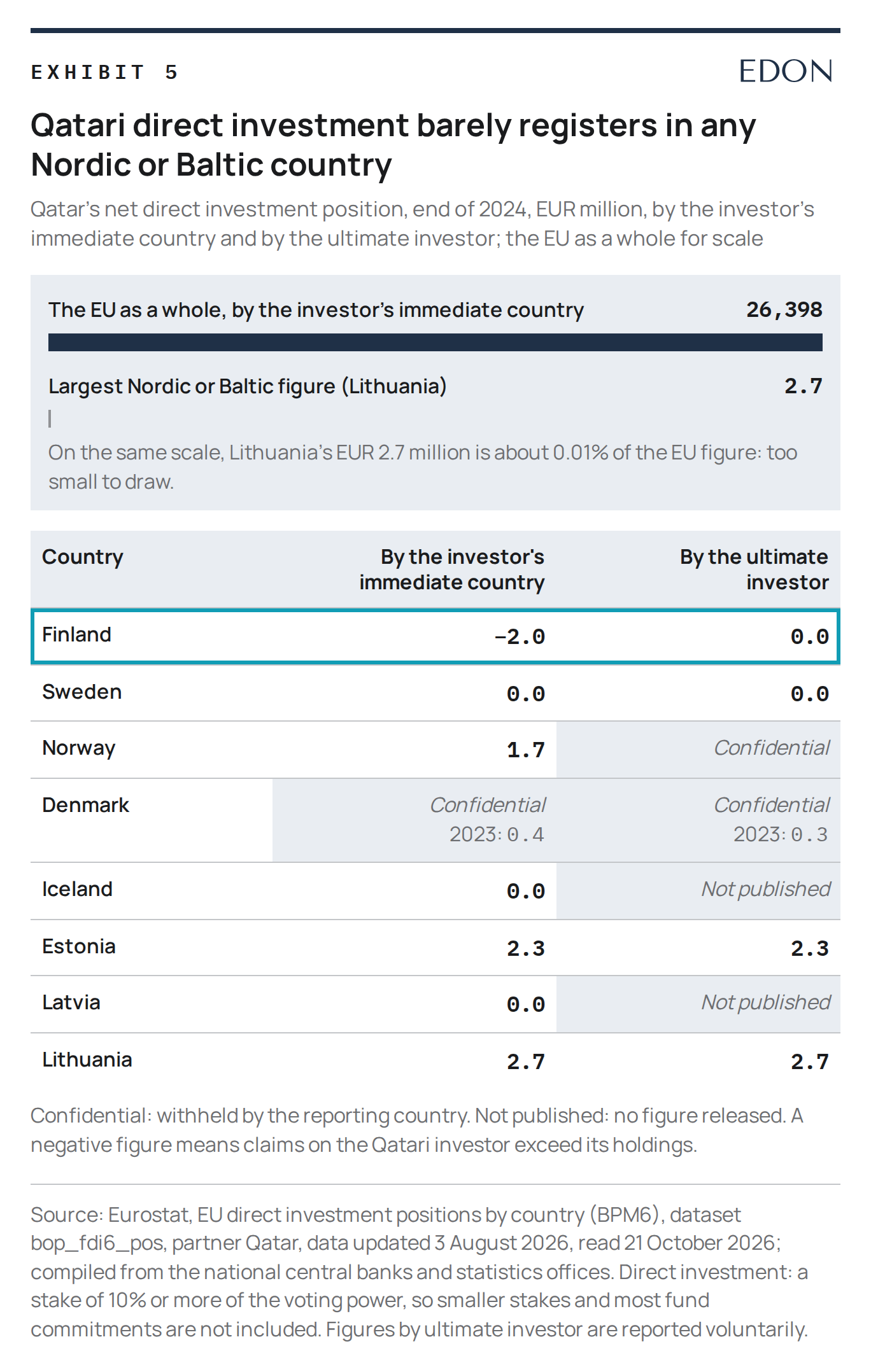
Exhibit 5. Qatari direct investment barely registers in any Nordic or Baltic country. Qatar's net direct investment position in eight Nordic and Baltic countries and in the EU, end of 2024, EUR million. Source: Eurostat, EU direct investment positions by country (BPM6), dataset bop_fdi6_pos, partner Qatar, data updated 3 August 2026, read 21 October 2026; compiled from the national central banks and statistics offices. Direct investment means a stake of 10% or more of the voting power; fund commitments and smaller stakes are not included. Figures by ultimate investor are reported voluntarily.
Finland is the wrong first move for an investor that needs control of a defence or infrastructure company by a fixed date, because the approval may not come by then. It is also a poor fit for an investor that writes only large cheques, since all foreign venture and growth investors together put EUR 494 million into Finnish startups in 2025. If the plan is to build an operating business in Finland rather than invest in one, EDON's piece on entering Finland from the Middle East is the better starting point.
The route and its approval path come first. For a family office or financial investor new to Finland, EDON suggests starting with a fund commitment alongside Tesi: it is the lightest route on approvals, and it builds knowledge of Finnish deal flow before a direct stake. A corporate investor with an industrial plan of its own, such as an energy or data centre operator, may do better to go straight to a project, with the screening and the land permit in the timetable from the start. If you want to test a first route before you commit, EDON offers a free 30-minute sparring session (opens in a new tab), with no obligation.
EDON is a strategy and transformation firm based in Finland. It works on finding and screening targets and partners, and on entry into Finland, with legal work done by legal partners. The screening decision stays with the Ministry, and the legal and tax questions with your lawyer and tax adviser.
If this is on your desk right now, EDON offers a free 30-minute sparring session, with no obligation.
Related

