
Strategy · M&A, Partnerships and Market Entry
If this is on your desk right now, EDON offers a free 30-minute sparring session, with no obligation.
Book 30 minutes (opens in a new tab)
Finland plans to cut its corporate tax rate from 20% to 18% in 2027 and let companies deduct business losses for 25 years instead of 10. Evidence from Finland and the rest of Europe suggests the rate cut will seldom decide an investment on its own. The longer loss period can change whether to keep, close or sell a loss-making company; EDON suggests owners start there.
Both measures sit in a Government proposal (HE 151/2026) and remain planned until Parliament passes them. The Finnish Tax Administration (opens in a new tab) and your own tax adviser are the authorities on how the rules apply to your company.
The Ministry of Finance published the proposal (opens in a new tab) on 3 September 2026, the day the Government submitted it to Parliament with the 2027 budget. The rate would fall to 18% from tax year 2027, and prepayments would follow. The loss deduction period would rise from 10 to 25 years for losses from tax year 2026 onward. Losses from 2025 and earlier keep the 10-year period, as do the losses of natural persons carrying on a business. The rule on losses after a change of owner stays as it is.
The Ministry's stated aim is to improve operating conditions and encourage investment, especially in sectors where development and testing take years before a product earns money. In its April consultation release (opens in a new tab) it put the static cost to the state at about 832 million euros a year.
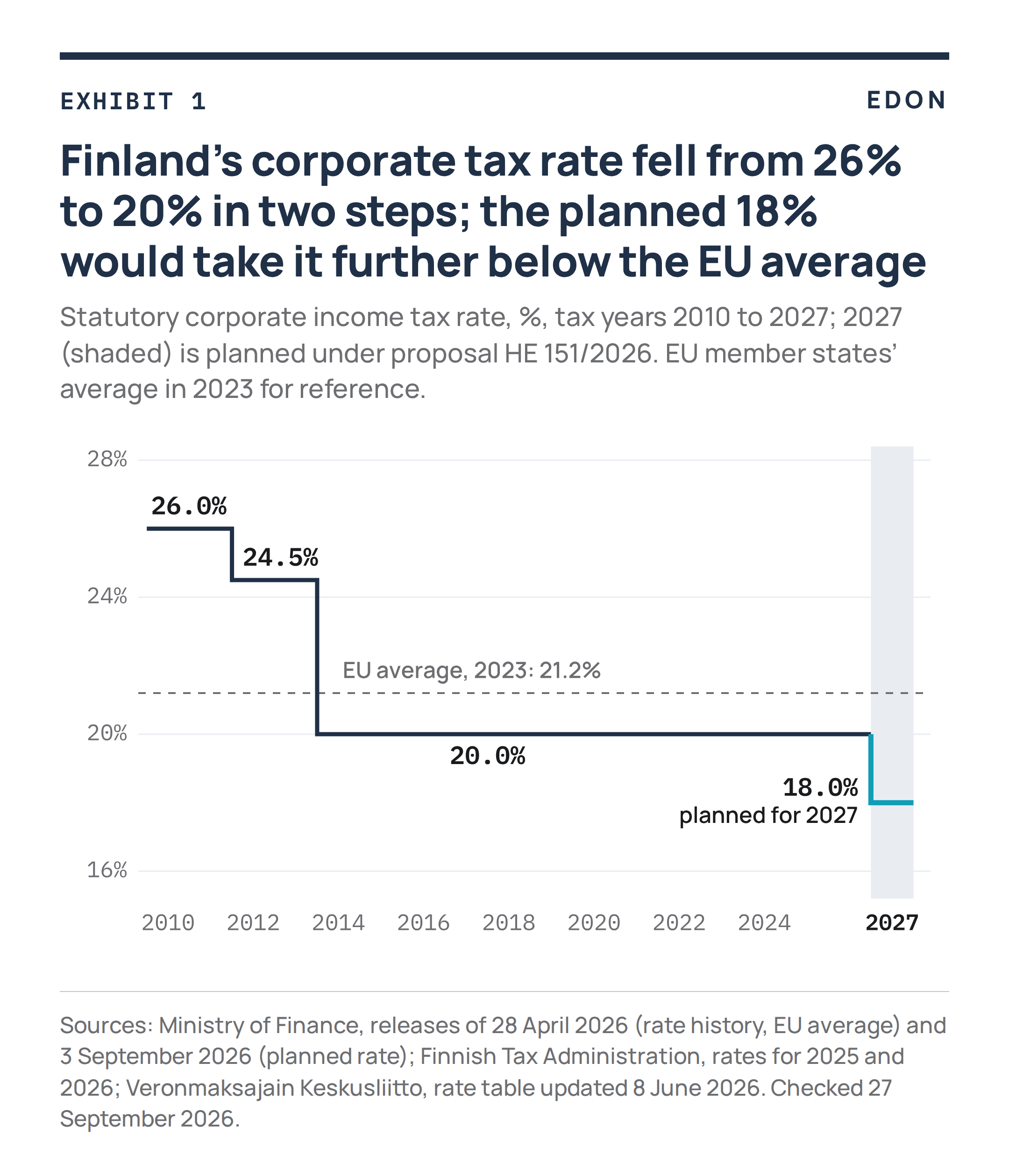
Exhibit 1. Finland's corporate tax rate fell from 26% to 20% in two steps; the planned 18% would take it further below the EU average. Statutory corporate income tax rate, tax years 2010 to 2027. The 2027 rate of 18% is planned under Government proposal HE 151/2026 and is not yet law; the dashed line is the EU member states' average in 2023 (21.2%). Sources: Ministry of Finance, 28 April and 3 September 2026; Finnish Tax Administration; Veronmaksajain Keskusliitto, 8 June 2026. Checked 27 September 2026.
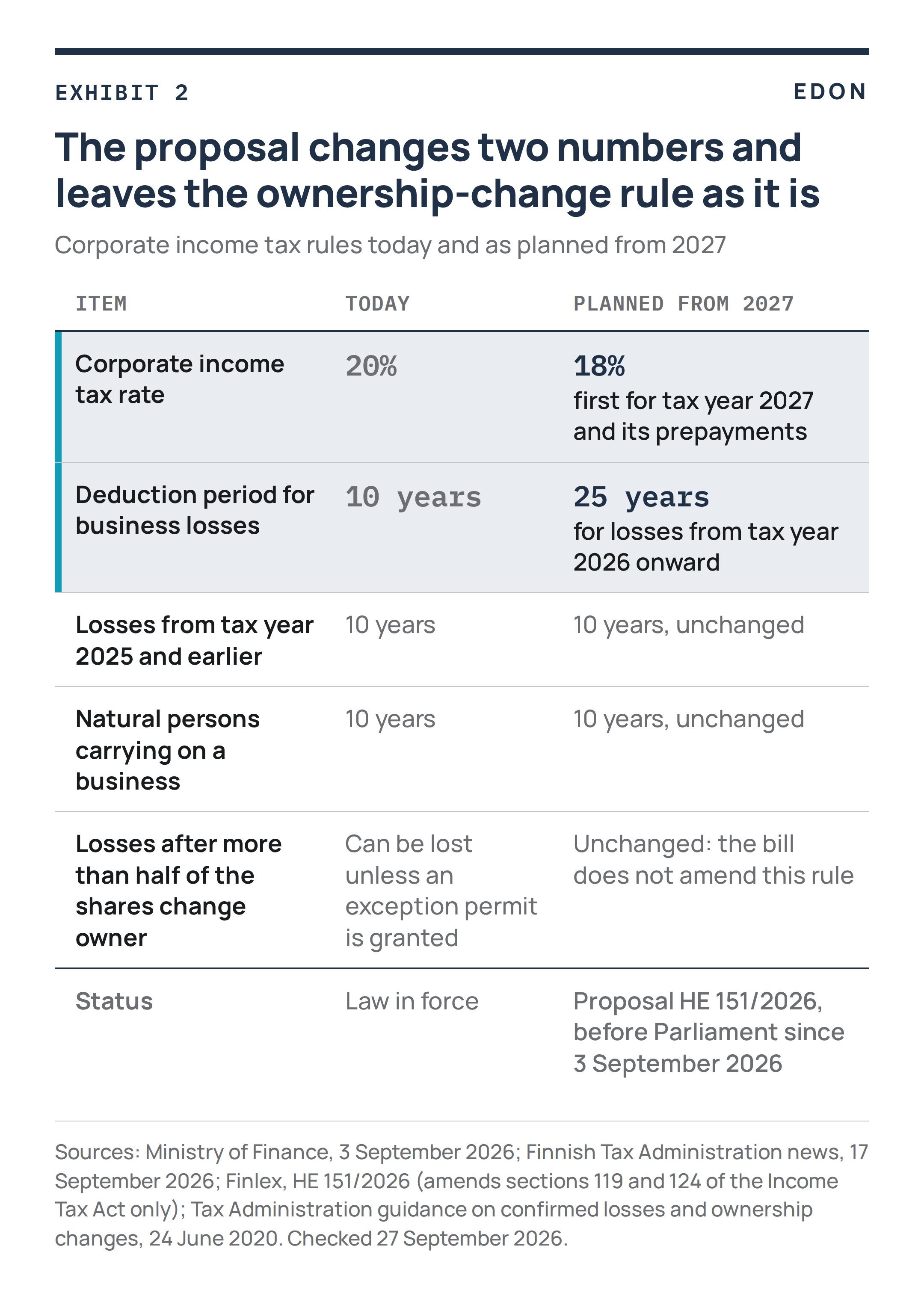
Exhibit 2. The proposal changes two numbers and leaves the ownership-change rule as it is. Corporate income tax rules today and as planned from 2027. Sources: Ministry of Finance, 3 September 2026; Finnish Tax Administration news, 17 September 2026; Finlex, HE 151/2026 (amends sections 119 and 124 of the Income Tax Act only); Tax Administration guidance on confirmed losses and ownership changes, 24 June 2020. Checked 27 September 2026.
The rate alone rarely justifies either. At 20% a company keeps 80 euros of every 100 euros of pre-tax profit; at 18% it keeps 82. A two-point cut adds 2.5% to after-tax profit, so an investment that needs it to clear the hurdle was marginal before the proposal and is marginal now.
After Finland cut the rate from 26% to 20% between 2012 and 2014, a study of small corporations (opens in a new tab) (Harju, Koivisto and Matikka, Journal of Public Economics, 2022) found no measurable change in their average investment. Annual sales were about 1.6% higher, mostly in cash-constrained firms and firms whose main owner works in the business.
A simple check, which EDON calls the flip test, is to re-run the investment plan at 18% and list every decision that changes. If the cuts of 2012 and 2014 are a guide, the list will usually be short. Expect more entries from a cash-constrained company, the kind of firm whose sales rose after the last cut, and from a group comparing countries for a new plant.
Timing has a small effect. A euro of deduction saves 20 cents of tax in 2026 and 18 cents in 2027, and income that lands in 2027 is taxed two points less. Two cents per euro moved is small enough to leave to the tax adviser, except for a large one-off deduction or disposal near the year end.
For a marginal project, demand and the cost of financing are the better tests. The Bank of Finland's forecast of 23 September 2026 (opens in a new tab) expects growth of 1.7% this year and 1.6% in 2027, led by private non-residential investment in manufacturing machinery and data centres. It assumes three-month Euribor rising from 2.4% this year to 3.0% in 2027, which weighs most on projects financed with floating-rate debt.
The cut has credible critics. Tuomas Matikka and Marika Viertola of the VATT Institute for Economic Research told the Ministry on 29 May 2026 (opens in a new tab) that, even allowing for its effects on the economy, the cut would cost the state at least 500 million euros a year. About 3% of companies pay nearly 60% of Finland's corporate tax, they noted, and research typically finds smaller investment effects in large firms than in small, growing ones. None of this changes a project's cash flows. A business case that works only if tax policy keeps moving in the company's favour rests on a contested political assumption, and EDON would ask for that assumption to be written down for the board.
Exhibit 3 compares Finland's cuts of 2012 and 2014 with those of seven other European countries, including Sweden, Denmark and Norway. The cuts ranged from two points in Croatia and Austria to ten in Hungary, which replaced a top rate of 19% with a flat 9% in 2017 (OECD data compiled by the Tax Foundation (opens in a new tab)).
Growth afterwards did not follow the tax rate. Measured against the EU average with Eurostat's GDP data (opens in a new tab), growth weakened after the cut in five of the eight countries, Finland among them, and strengthened in three. In the three years after its cut, Hungary's lead over the EU widened from 1.5 to 2.7 percentage points a year. Taking 2017 to 2025 as a whole, the lead averaged 0.9 points, and in each year from 2023 to 2025 Hungary grew more slowly than the EU. Adding Italy, Spain, Luxembourg and Portugal, whose cuts left enough years before COVID to compare, gives the same mixed picture.
Larger forces were at work in each period. Norway absorbed a 70% fall in the oil price (opens in a new tab) between mid-2014 and early 2016, and Austria an industrial recession (opens in a new tab) after a spike in energy prices. A tax cut's own effect cannot be read from these numbers.
A meta-analysis of 441 estimates from 42 studies (opens in a new tab) across many countries (Gechert and Heimberger, European Economic Review, 2022) found that studies showing growth gains from corporate tax cuts were more likely to be published; correcting for that bias, the authors could not reject a zero effect on growth.
For a group choosing a country for a new plant, current cuts matter more than history. Portugal is lowering its general rate one point a year, to 18% in 2027 and 17% in 2028 (opens in a new tab), and Germany will cut its federal corporate tax from 15% to 10%, one point a year from 2028 (opens in a new tab). Headline rates can mislead, so EDON would compare the whole tax bill. The Tax Foundation (opens in a new tab) puts Portugal's combined top rate at 29.5% in 2026, and Germany's Finance Ministry expects the total tax burden on companies there to be just under 25% from 2032. Hungary's 9% (opens in a new tab) comes with a local business tax of up to 2% on sales less certain costs, which can fall due in a loss-making year, and groups with revenue of 750 million euros or more are subject to the 15% global minimum tax.
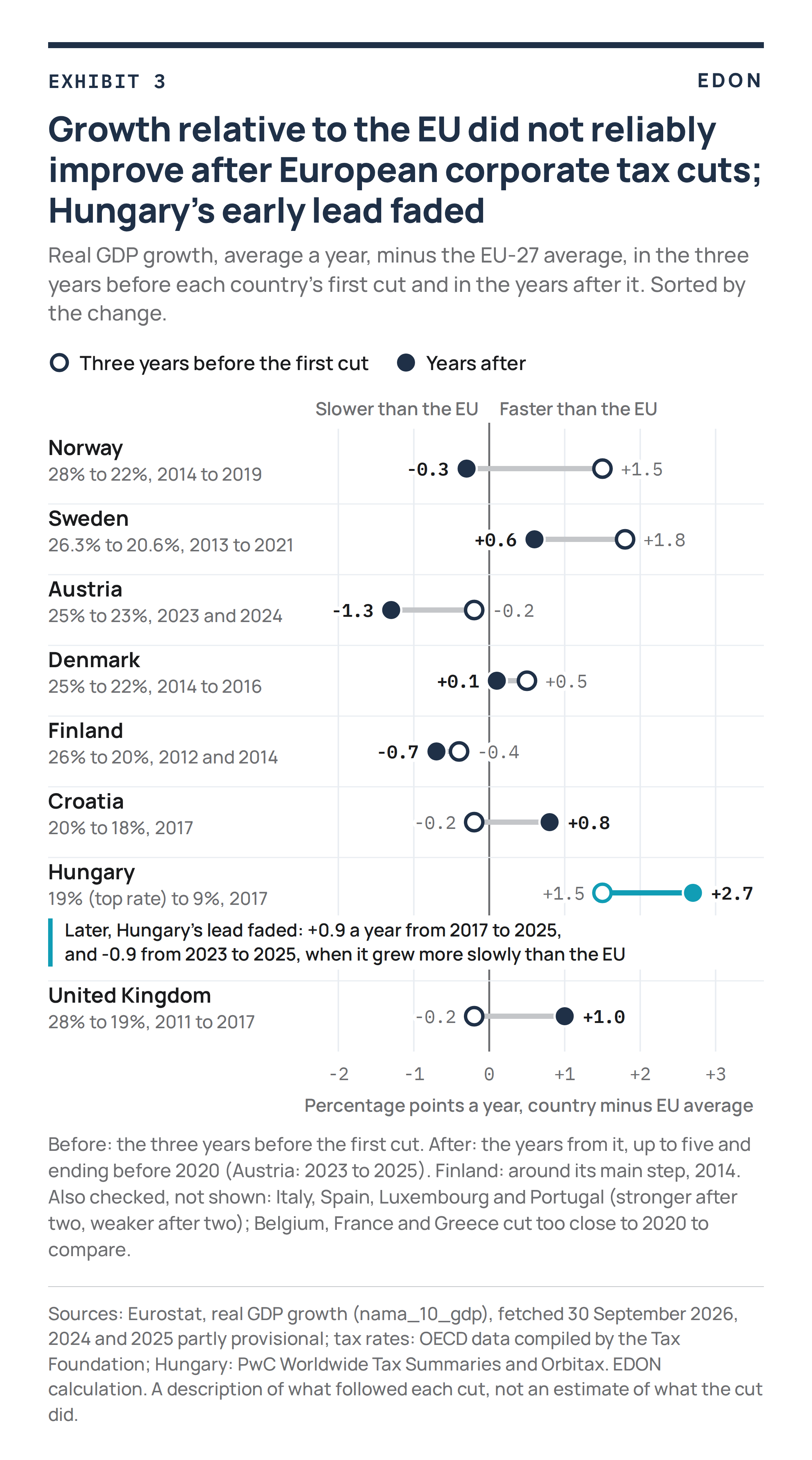
Exhibit 3. Growth relative to the EU did not reliably improve after European corporate tax cuts; Hungary's early lead faded. Real GDP growth, average a year, minus the EU-27 average, in the three years before each country's first corporate tax cut and in the years after it (up to five, ending before 2020; Austria 2023 to 2025; Finland around its main step in 2014). A description of what followed each cut, not an estimate of what the cut did. Sources: Eurostat, real GDP growth (nama_10_gdp), fetched 30 September 2026, 2024 and 2025 partly provisional; tax rates: OECD data compiled by the Tax Foundation; Hungary: PwC Worldwide Tax Summaries and Orbitax. EDON calculation.
For a company that carries losses and faces a slow recovery, the loss rule can be worth far more than the rate cut. A loss is worth something only if the company that made it later earns taxable profit to deduct it from. With 10 years, a slow recovery can leave part of the loss unused; with 25 years, far more of it survives. In the illustration in Exhibit 4, the longer period saves 180,000 euros more tax, all of it between 2037 and 2046. On the same profit, the rate cut is worth 2,000 euros a year once the losses are used up.
The gain is largest for a standalone company or a group with little Finnish profit elsewhere. Within a Finnish group of at least 90% ownership, group contributions from profitable companies can absorb the losses within ten years if the group earns enough; the Tax Administration's guidance (opens in a new tab) (in Finnish) sets the conditions. A business back in healthy profit within ten years uses its losses under either rule.
The longer period also brings Finland closer to its neighbours. Sweden and Norway set no time limit on business losses; Denmark sets none either, but above a threshold a company can use them against only 60% of its yearly taxable income, according to the Tax Foundation (opens in a new tab).
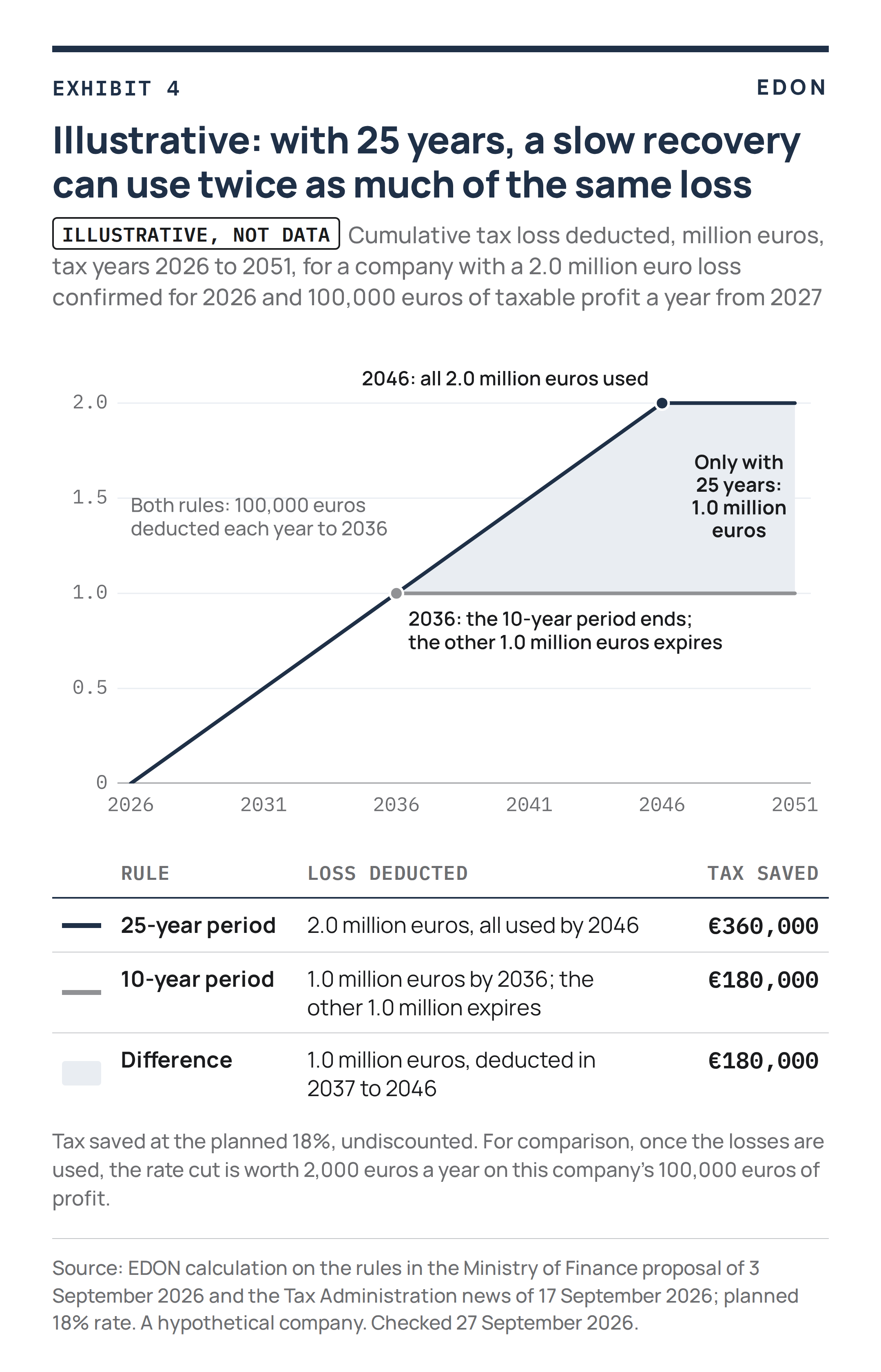
Exhibit 4. Illustrative: with 25 years, a slow recovery can use twice as much of the same loss. Illustrative, not data. Cumulative tax loss deducted by a hypothetical company with a 2.0 million euro loss confirmed for 2026 and 100,000 euros of taxable profit a year from 2027, under the current 10-year period and the planned 25-year period. Tax saved at the planned 18%, undiscounted. Source: EDON calculation on the rules in the Ministry of Finance proposal of 3 September 2026 and the Tax Administration news of 17 September 2026. Checked 27 September 2026.
The longer period bears on three decisions.
Keeping or closing a business. A business with a credible but slow path back to profit now carries a larger tax asset if it stays inside the company that made the loss. One with no path back stays a closure case; the arithmetic moves only when recovery is real but slow. For that call, EDON's Turnaround Toolkit starts with cash and a 13-week cash forecast.
Selling or bringing in a new owner. Under the Income Tax Act, a company can lose its confirmed losses when more than half of its shares change owner, unless the Tax Administration grants an exception permit (poikkeuslupa) (opens in a new tab). Indirect changes count, such as a new majority owner in a shareholder that holds 20% or more; shares passed on by inheritance or will do not. Longer-lived losses make the rule more expensive to trigger. The permit is not automatic, and it can be sought before the change. EDON suggests checking the rule before terms are agreed whenever the losses matter to the price.
Starting something that will lose money for years. A new product line or a development project that burns cash for five to seven years is the case the Ministry had in mind. Which company houses it, and where its early losses land, now matters over a much longer horizon.
Acting on the new rules is the wrong move when tax drives a decision that the business case does not support. At the planned rate, a euro of tax loss is worth at most 18 cents, and only if profit arrives. Keeping a business alive to protect that asset is a poor trade if it keeps consuming cash. EDON also suggests waiting for Parliament before acting on the planned rules, unless a decision makes sense under today's rules too. A restructuring can wait until your tax adviser has confirmed how the ownership-change rule and the transition apply to your group.
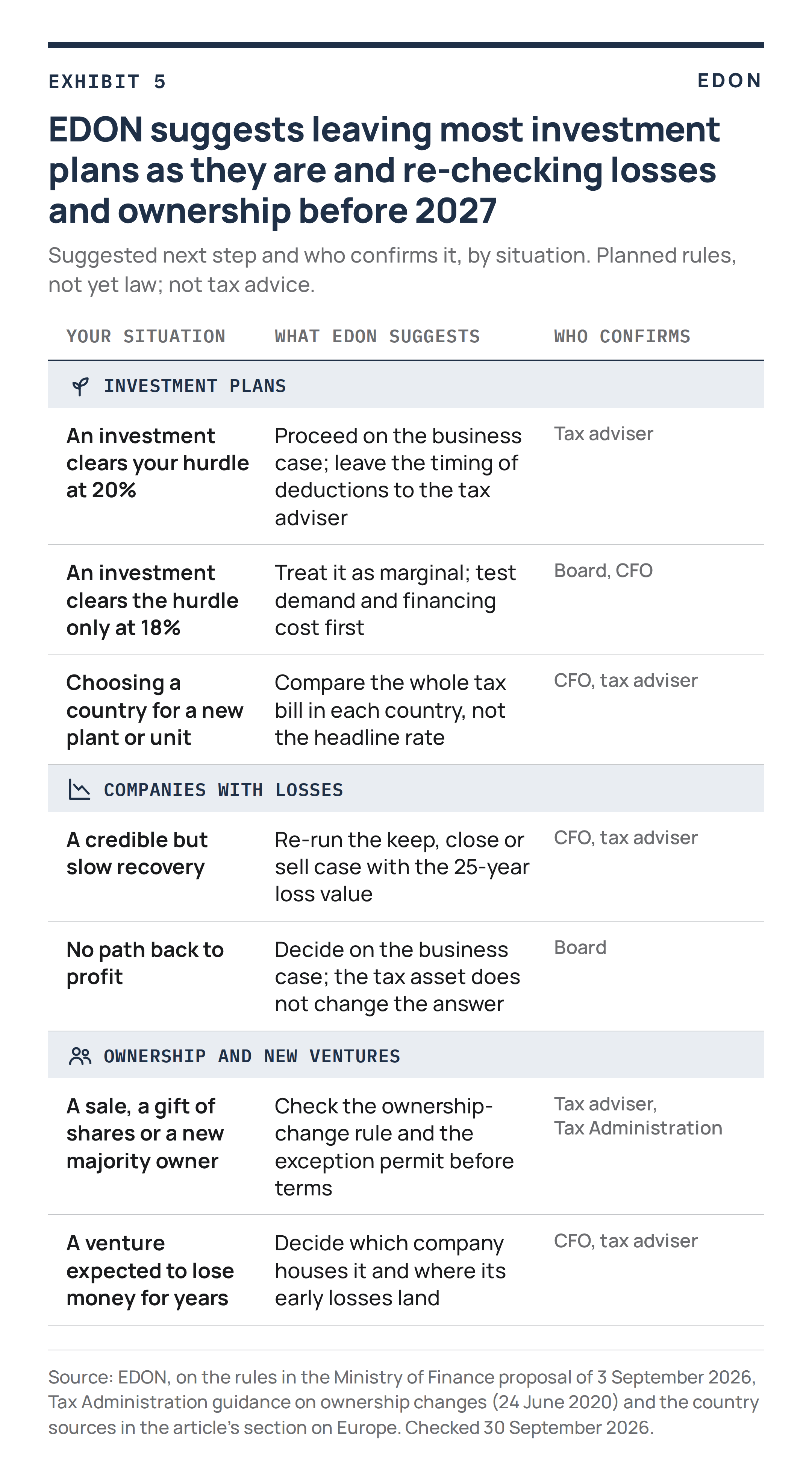
Exhibit 5. EDON suggests leaving most investment plans as they are and re-checking losses and ownership before 2027. Suggested next step and who confirms it, by situation. Planned rules, not yet law; not tax advice. Source: EDON, on the rules in the Ministry of Finance proposal of 3 September 2026, Tax Administration guidance on ownership changes (24 June 2020) and the country sources in the article's section on Europe. Checked 30 September 2026.
EDON suggests two steps. First, ask the CFO to run the flip test on the investment plan. If nothing flips, the cut simply adds to after-tax profit. Second, list every company in the group with confirmed losses, the year each loss arose and any planned change of ownership. Only losses from 2026 onward would get 25 years, and an ownership change can forfeit them, so that list shows where the value sits.
EDON is a strategy and transformation firm based in Finland. It works with owners and boards on which parts of a portfolio to grow, fix or exit, and on making the changes work. The tax treatment stays with the Tax Administration and your adviser.
If this is on your desk right now, EDON offers a free 30-minute sparring session, with no obligation.
Related


Resources for this capability
Six stages, from an honest baseline and an emergency plan to the reviews that keep the handover standing. Free to read.
