
Strategy · M&A, Partnerships and Market Entry
If this is on your desk right now, EDON offers a free 30-minute sparring session, with no obligation.
Book 30 minutes (opens in a new tab)
Saudi Arabia's local content requirements bar some imported products from government and state-owned tenders, and in large government works and service contracts they give local content 40% of the financial score. For a Nordic supplier, EDON suggests settling what to localise, and how to enter the market, before the first bid.
The rules come from the Local Content and Government Procurement Authority (opens in a new tab) (LCGPA), under a regulation of 2019 (opens in a new tab) (Council of Ministers Resolution No. 245), and they keep moving. They reached state-owned companies in 2022 and 2024, and LCGPA plans new requirements (opens in a new tab) for consulting and IT tenders from April 2027. On 4 August 2026 the Council of Ministers approved a new Government Tenders and Procurement Law (opens in a new tab), which the Ministry of Finance says will support industrial localisation. The announcement set no date for it to take effect. Each tender's documents name the mechanisms that apply. How they apply to your company, and to the structures discussed below, is for LCGPA and your local counsel to confirm.
Five of LCGPA's mechanisms matter to a foreign supplier: a mandatory list, a price preference for national products, a local content weight in the financial score, minimum local content and a preference for local SMEs (Exhibit 1). Which ones a supplier meets depends on its product and the contract's size.
The mandatory list names national products that a buyer and its contractors must use throughout a contract, and a bid that ignores it is disqualified or loses the items concerned. Exemptions exist, for example when Saudi factories lack capacity or charge more than 10% above the foreign price, but only the buyer can apply for one.
The price preference counts foreign products as 10% dearer when bids are compared, and local small and medium-sized enterprises get a 10% preference of their own. LCGPA defines a national product as anything manufactured in the Kingdom, including goods at a later stage of assembly or processing.
In high-value contracts, which LCGPA's guidance on the mechanisms (opens in a new tab) sets at SAR 25 million or more with supply contracts excepted, price counts for 60% of the financial score and local content for 40%. The local content score is the average of the target the bidder declares for the contract and the company's certified baseline, plus five points for a company listed on the Saudi capital market. In the same contracts a minimum local content can apply, which the contractor must reach by the end of the contract; a bid below it is excluded.
The rules have bound wholly state-owned companies since 18 December 2022, and since 18 December 2024 any company registered in the Kingdom in which the state holds more than half of the capital, according to LCGPA's guidance for state-owned companies (opens in a new tab). For these buyers the mandatory list covers every contract. The price preference applies to all their supply tenders and to works and service tenders of SAR 50 million or more, and the local content weight applies only to those larger works and service tenders.
The baseline is the company's local content certificate. It measures what the company spends in the Kingdom on Saudi staff, goods and services, productive assets and technology, using LCGPA's template and a report from an accredited office. LCGPA's service standard (opens in a new tab) is to issue it within ten working days of a complete application. For a supplier that only ships from abroad, the baseline starts near zero.
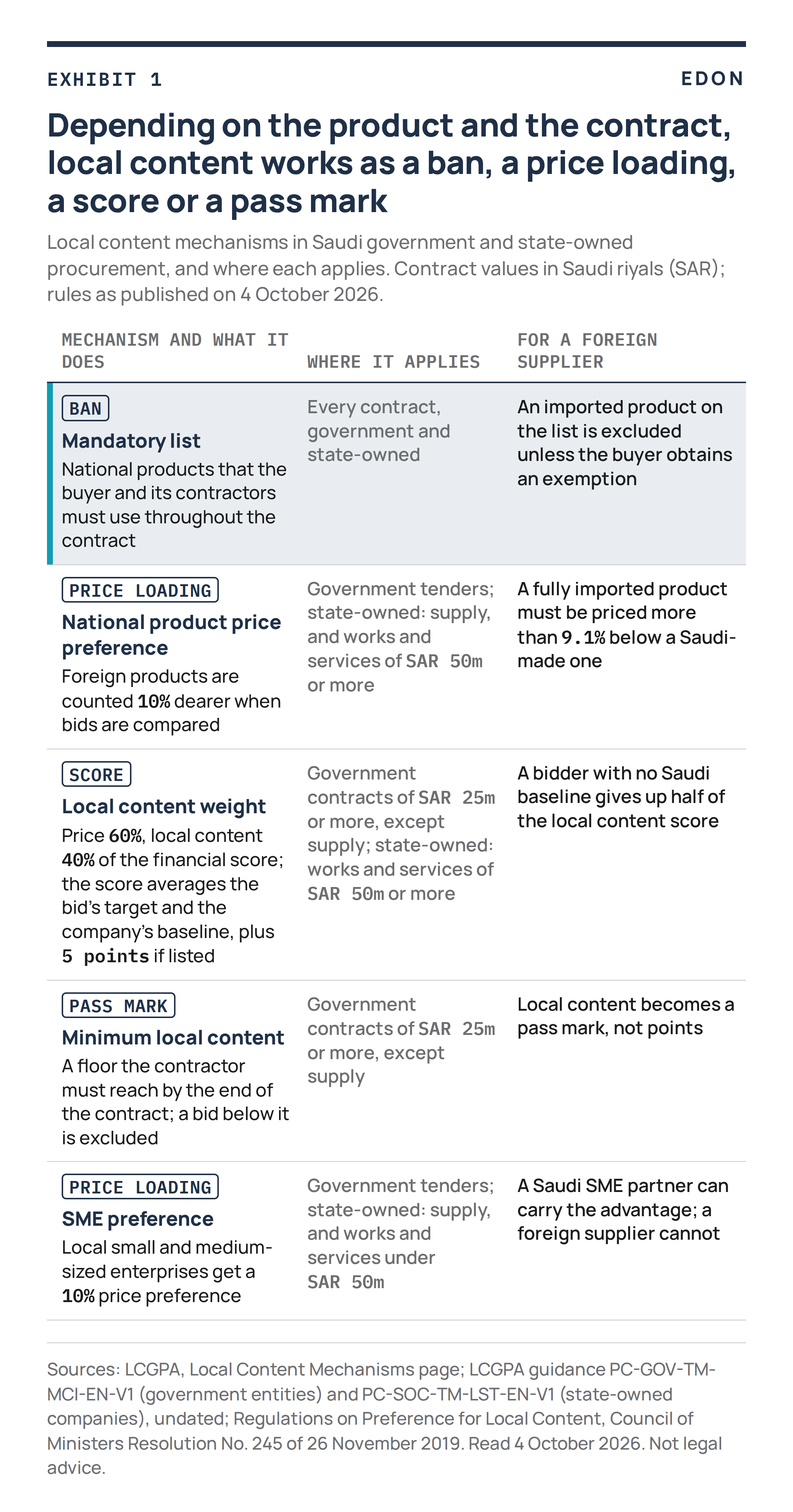
Exhibit 1. Depending on the product and the contract, local content works as a ban, a price loading, a score or a pass mark. Five local content mechanisms in Saudi government and state-owned procurement, where each applies and what it means for a foreign supplier; contract values in Saudi riyals. Sources: LCGPA, Local Content Mechanisms page; LCGPA guidance PC-GOV-TM-MCI-EN-V1 (government entities) and PC-SOC-TM-LST-EN-V1 (state-owned companies), undated; Regulations on Preference for Local Content, Council of Ministers Resolution No. 245 of 26 November 2019. Read 4 October 2026. Not legal advice.
In a large contract, a bidder that trails on local content must undercut its rival by two-thirds of the score gap, measured as a percentage of the rival's price. Every 15 points of local content score are worth a 10% lower price (Exhibit 2).
LCGPA's worked example shows the effect. One bidder, with a 30% target and no baseline, had a local content score of 15 and offered SAR 450 million. A listed rival, with a 40% target and a 25% baseline, scored 37.5 and offered SAR 455 million. The rival won on financial score, 74% against 66%. Trailing by 22.5 points, the first bidder needed a price about 15% below its rival's; it was 1.1% below.
In supply tenders the cost is the 10% loading: a fully imported product must be priced more than 9.1% below a Saudi-made one to win. For a supplier whose operating margin is below that, absorbing the loading means losing money on the tender.
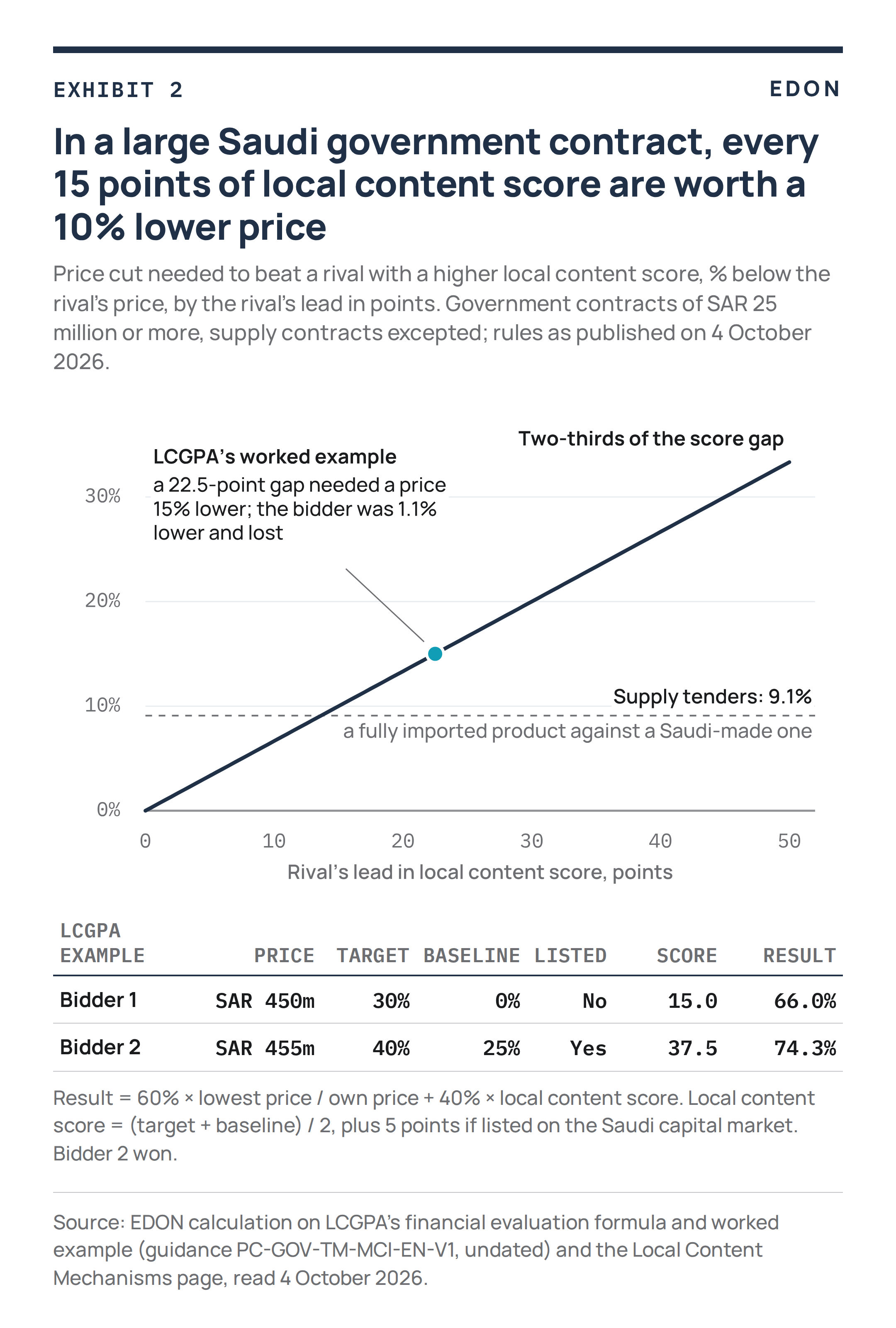
Exhibit 2. In a large Saudi government contract, every 15 points of local content score are worth a 10% lower price. Price cut needed to beat a rival with a higher local content score, % below the rival's price, by the rival's lead in points; government contracts of SAR 25 million or more, supply contracts excepted. LCGPA's worked example highlighted: a 22.5-point gap needed a price 15% lower, and the bidder, 1.1% lower, lost. Dashed line: in supply tenders a fully imported product needs a price 9.1% below a Saudi-made one. Source: EDON calculation on LCGPA's financial evaluation formula and worked example (guidance PC-GOV-TM-MCI-EN-V1, undated) and the Local Content Mechanisms page, read 4 October 2026.
EDON suggests starting with the mechanism that governs your tenders, since each calls for a different lever.
A product on the mandatory list competes only if it is made in the Kingdom, so a lower price or sales-office hires change nothing. The options are contract manufacturing or a licence with a Saudi manufacturer, or a plant of your own.
Equipment sold in supply tenders faces the 10% loading instead. Final assembly in the Kingdom may be enough to lift it, since LCGPA's definition of a national product covers goods at a later stage of assembly.
Large works and service contracts work differently. There, the target half of the score depends on spending in the Kingdom during the contract (Saudi staff, Saudi suppliers, local service and spare parts), while the baseline half belongs to the bidding company and reflects what it already does there.
Selling through a Saudi contractor does not take you out of the calculation. Local content counts spending in the Kingdom, so imported equipment lowers the contractor's own target. EDON expects a contractor facing a minimum to ask suppliers to localise part of the scope, such as assembly, service or spare parts, or to find a local alternative.
EDON suggests the fastest route that meets the mechanism in your tenders; Exhibit 3 compares five, from a Saudi distributor to a plant of your own. The quick routes leave your product foreign and the score with your partner. That suits supply tenders for products off the mandatory list, where the loading can be priced in and the work goes into choosing the channel partner. A Saudi manufacturer working under contract or licence can make the product national without a plant of your own.
Joint ventures need care. A newly formed joint venture company has no spending in the Kingdom yet and so nothing to certify; in the first tenders, the partner's established company, with your scope inside its bid, may score better. A Saudi company of your own builds a baseline slowly, and EDON suggests setting one up only for a pipeline of large contracts that runs for years. A plant is the full answer for a product on the mandatory list, and the slowest.
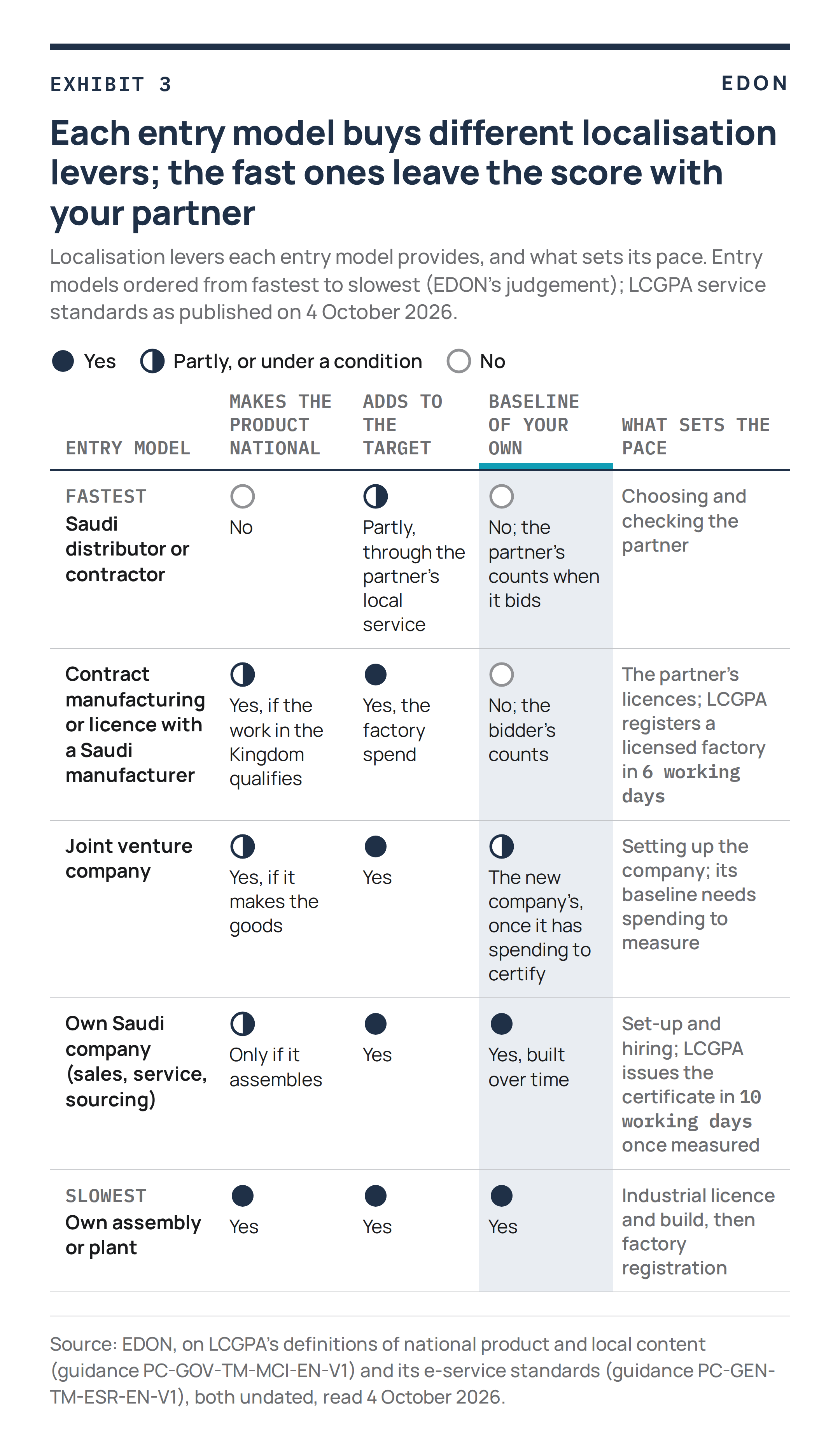
Exhibit 3. Each entry model buys different localisation levers; the fast ones leave the score with your partner. Five entry models, ordered from fastest to slowest (EDON's judgement), against three localisation levers, with what sets each model's pace. Source: EDON, on LCGPA's definitions of national product and local content (guidance PC-GOV-TM-MCI-EN-V1) and its e-service standards (guidance PC-GEN-TM-ESR-EN-V1), both undated, read 4 October 2026.
Each localisation step is paid for before the first award, so it makes sense only if the tenders you can win will repay it. One large tender, or a pipeline that hangs on a single buyer's budget, rarely justifies a Saudi company or a manufacturing deal. Supply tenders for products off the mandatory list, where your margin can carry the loading, may need no localisation at all, and state-owned buyers apply the local content weight only from SAR 50 million. The rules cover government entities and companies majority-owned by the state, so for some products private buyers are the better first target. If your product is on the mandatory list, your pipeline is thin and no Saudi manufacturer will take it on, EDON suggests leaving government and state-owned tenders aside.
EDON suggests starting with a list of the tenders you plan to bid for, by buyer, contract type and value, each marked with its mechanism; Exhibit 4 sorts the common cases. Check your products against LCGPA's current mandatory list, and choose the entry model and the partner on the score those tenders will demand. Before signing, ask local counsel what happens if a contractor falls short of its local content commitment.
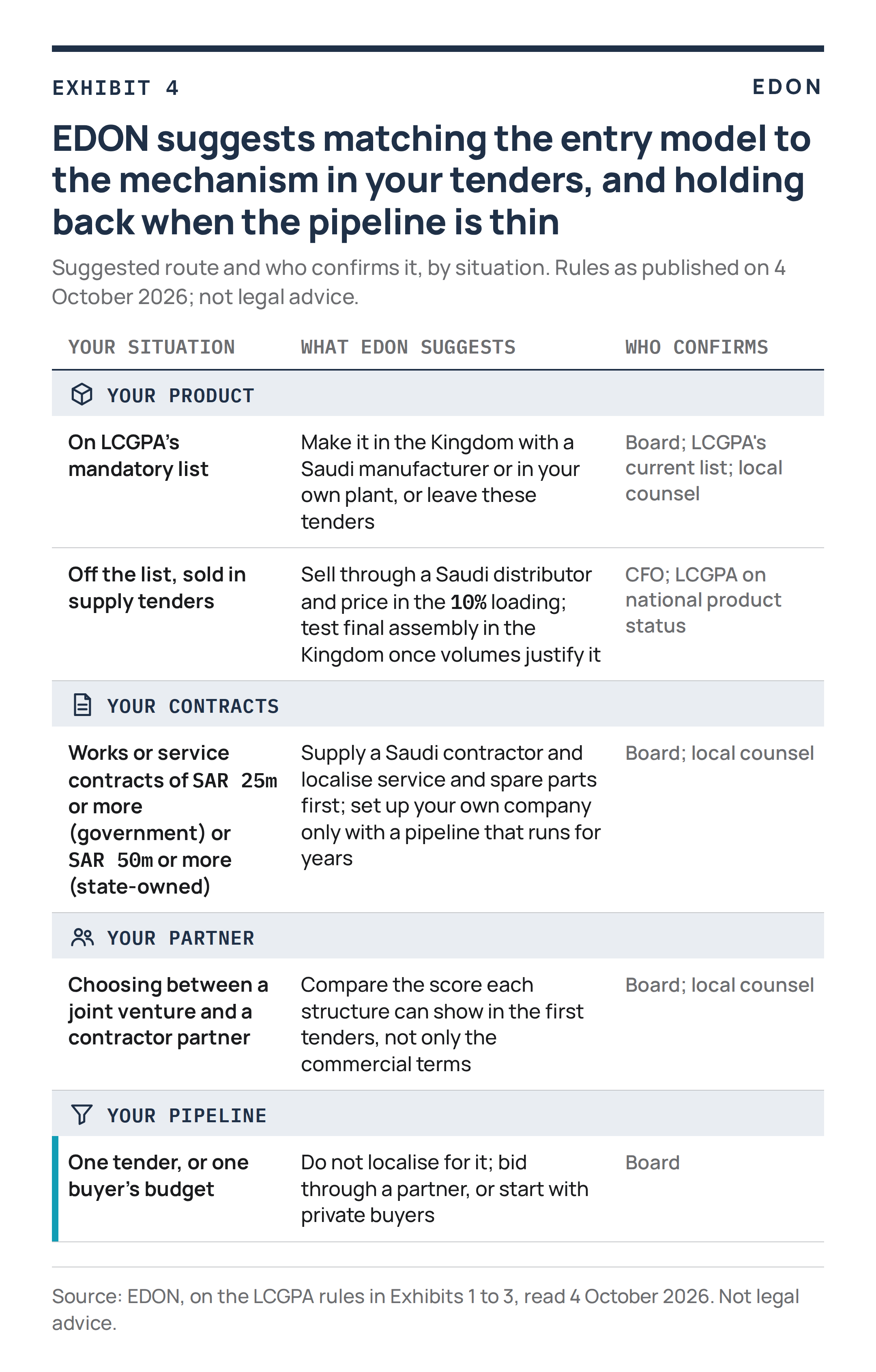
Exhibit 4. EDON suggests matching the entry model to the mechanism in your tenders, and holding back when the pipeline is thin. EDON's suggested route and who confirms it, for five situations grouped by product, contracts, partner and pipeline. Source: EDON, on the LCGPA rules in Exhibits 1 to 3, read 4 October 2026. Not legal advice.
EDON is a strategy and transformation firm based in Finland. It works with owners and boards on market entry and partnerships and on making the changes work.
If this is on your desk right now, EDON offers a free 30-minute sparring session, with no obligation.
Related

