
Strategy · M&A, Partnerships and Market Entry
If this is on your desk right now, EDON offers a free 30-minute sparring session, with no obligation.
Book 30 minutes (opens in a new tab)
For an owner selling a Finnish SME, the buyer's financing often decides how the price is paid. One in seven Finnish SMEs expects an ownership change within two years, and three in four of the SMEs interested in buying a company would need outside money. Before the price is negotiated, it is worth working out what a buyer can fund at closing, how much of the price to accept later, and on what security.
The price can be paid in four ways:
The later and less certain a payment, the less it is worth today and the more risk the seller keeps.
The share of Finnish SMEs expecting an ownership change within two years stood at 14% in the Pk-yritysbarometri 1/2026 (opens in a new tab) (in Finnish, 13 February 2026), unchanged from a year earlier. One in ten was interested in buying a company or a business over the same period, and 75% of those would need external financing. The autumn barometer (opens in a new tab) of 16 September 2026 did not repeat the questions.
The two figures cannot simply be set against each other, because an ownership change can be a family handover and buyers include individuals and investors as well as SMEs. Finnvera, though, used the headline of its review of the first half of 2025 (opens in a new tab) to name the imbalance between the numbers of sellers and buyers as the challenge of the next few years. Its financing of ownership changes rose in 2025 to 681 deals and 130 million euros (opens in a new tab), 13% more deals than in 2024 and almost a quarter more money.
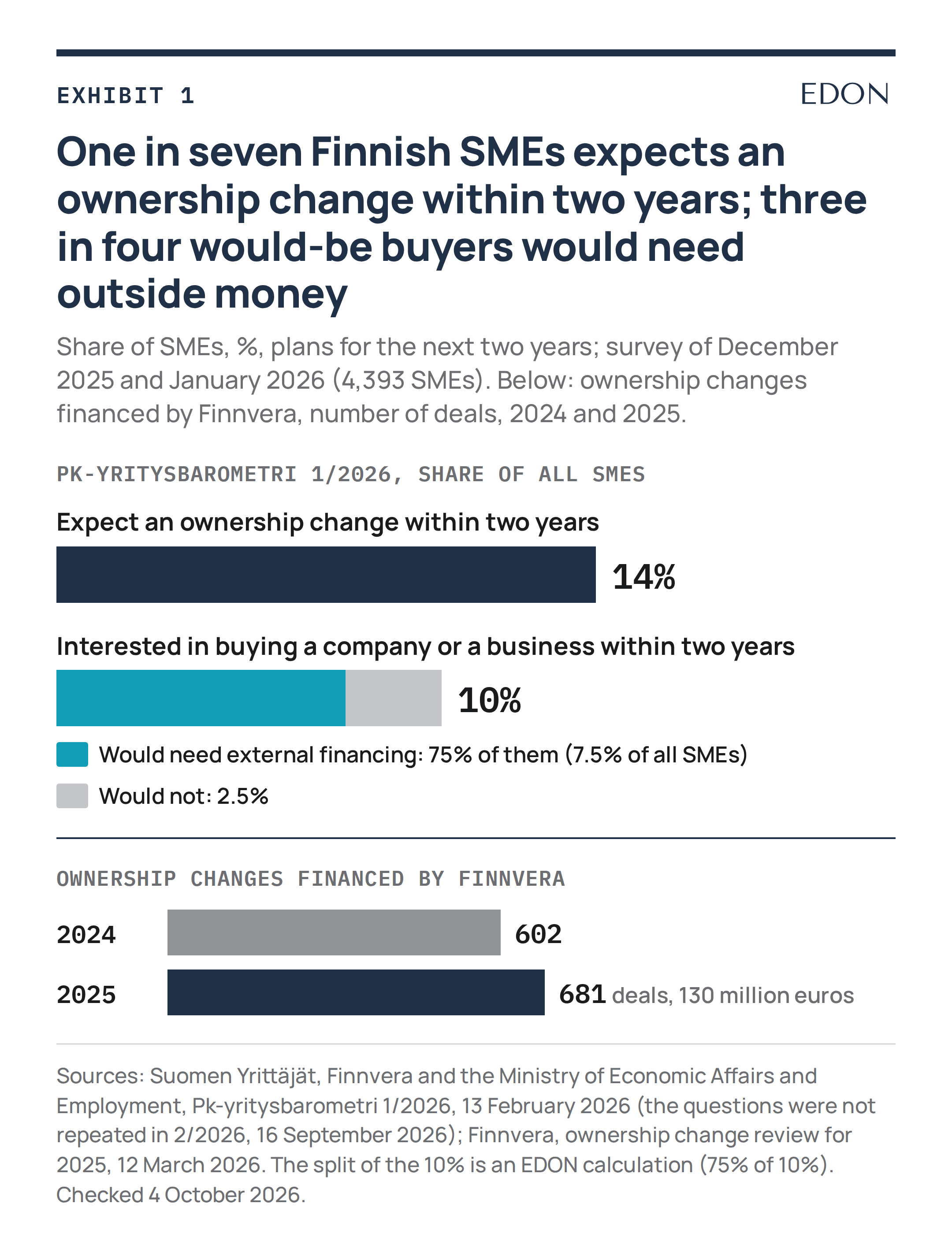
Exhibit 1. One in seven Finnish SMEs expects an ownership change within two years; three in four would-be buyers would need outside money. Share of Finnish SMEs that expect an ownership change, or are interested in buying a company or a business, within two years, with the share of interested buyers who would need external financing; below, the ownership changes Finnvera financed in 2024 and 2025. Sources: Suomen Yrittäjät, Finnvera and the Ministry of Economic Affairs and Employment, Pk-yritysbarometri 1/2026, 13 February 2026 (4,393 SMEs, surveyed in December 2025 and January 2026; the questions were not repeated in 2/2026 of 16 September 2026); Finnvera, ownership change review for 2025, 12 March 2026. The split of the 10% is an EDON calculation. Checked 4 October 2026.
A bank lends against the cash the company will generate, and that sets how much of the price can arrive at closing. In OP's guidance on financing an ownership change (opens in a new tab) (January 2023, in Finnish), an acquisition is typically not financed with a bank loan alone, the loan term is usually five years at most, and the debt must be repayable from the combined business's cash flow within that term. Stable cash flow, in OP's words, is the best security a bank can have. A Finnvera guarantee, typically 50% to 80% of the loan in OP's figures, makes lending easier, but the cash flow still has to repay the loan.
Whatever the buyer's own money and the bank leave uncovered, the seller is usually asked to carry. Where collateral falls short, OP lists a lower price and three fixes that leave part of the price with the seller: a loan from the seller, a sale of only part of the shares with the seller staying on as a minority owner, and payment in stages.
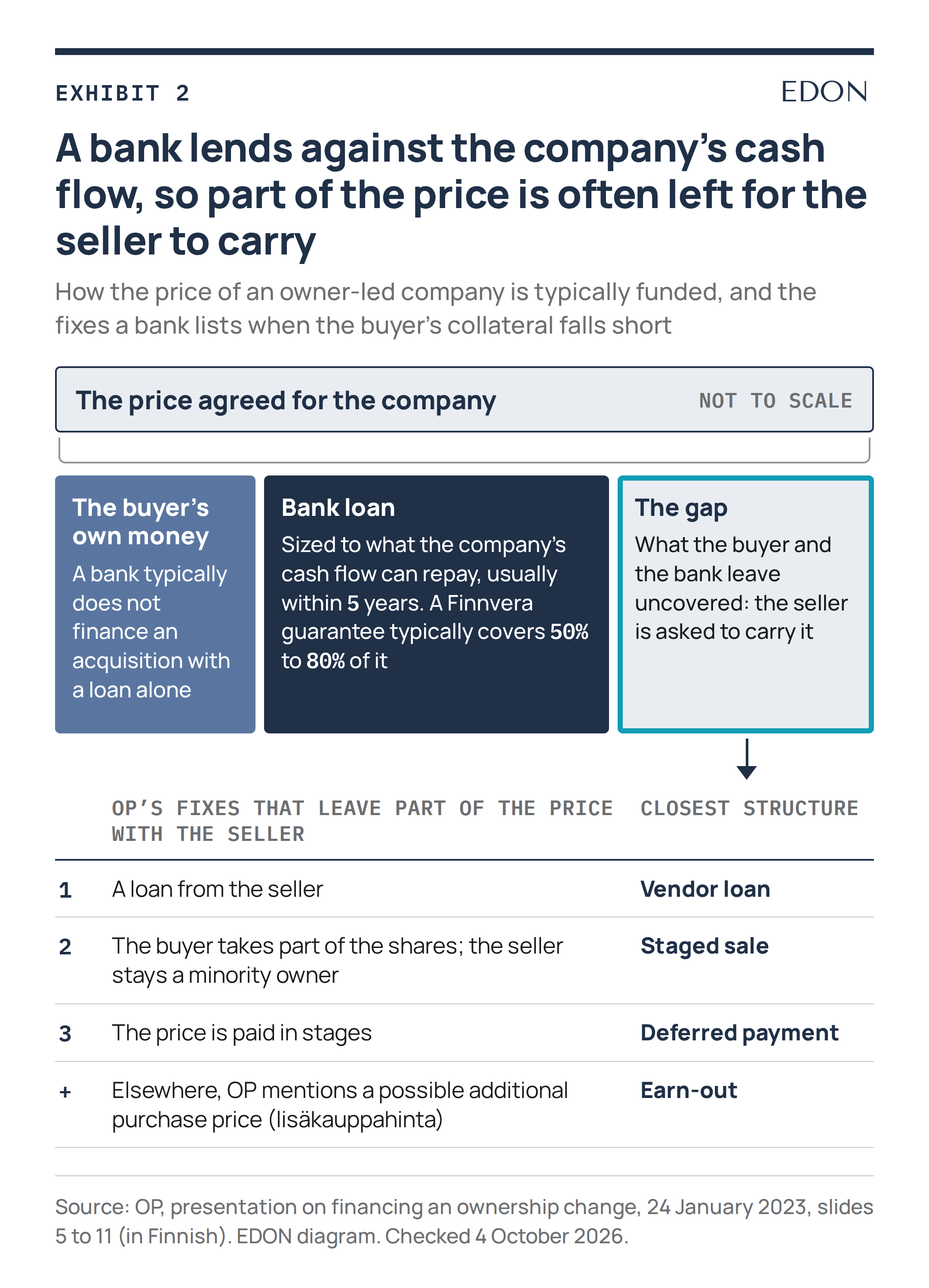
Exhibit 2. A bank lends against the company's cash flow, so part of the price is often left for the seller to carry. How the price of an owner-led company is typically funded: the buyer’s own money, a bank loan sized to what the company’s cash flow can repay (usually within five years, with a Finnvera guarantee typically covering 50% to 80% of it), and a gap the seller is asked to carry. Below, OP’s fixes that leave part of the price with the seller, and the closest structure for each. Not to scale. Source: OP, presentation on financing an ownership change, 24 January 2023, slides 5 to 11 (in Finnish). EDON diagram. Checked 4 October 2026.
An owner can estimate this gap before the first price conversation, starting from the cash flow a bank would lend against.
Discounting later payments at 10% a year and weighting the earn-out by its chance of paying, EDON's illustration (Exhibit 3) puts the same 2.0 million euro price at between 1.65 and 2.0 million today. A vendor loan for 30% of the price, repaid over three years with 5% interest, is worth 1.95 million if every instalment arrives, though 0.6 million is still unpaid after closing. A staged sale that leaves 40% of the shares to be bought after three years at a fixed price comes to 1.80 million. An earn-out of 30% of the price, due after two years with an even chance of meeting its target, is worth 1.65 million.
On these assumptions, an offer built on that earn-out needs a headline of about 2.43 million euros to match 2.0 million in cash. An even chance may be generous. In 2024 data from SRS Acquiom (opens in a new tab), a US firm, earn-outs paid out about 21% of their maximum and were contested at least 28% of the time. At that rate the earn-out above is worth 1.50 million today. Those are US deals, and Finnish SME sales may differ.
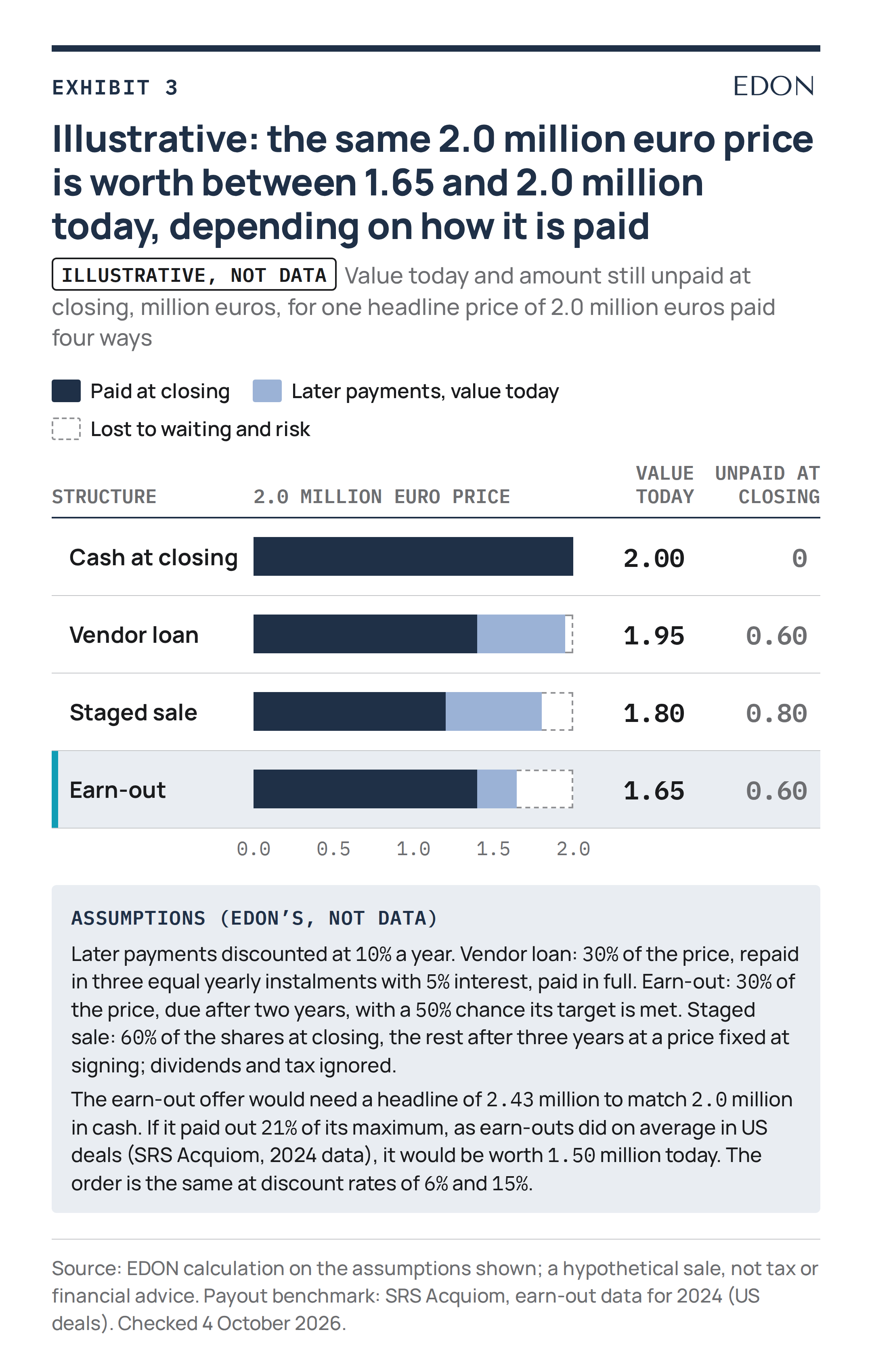
Exhibit 3. Illustrative: the same 2.0 million euro price is worth between 1.65 and 2.0 million today, depending on how it is paid. Illustrative, not data. Value today and amount unpaid at closing for one headline price of 2.0 million euros paid four ways, on EDON’s assumptions: later payments discounted at 10% a year; a vendor loan of 30% repaid over three years with 5% interest; an earn-out of 30% due after two years with a 50% chance of being met; a staged sale of 60% of the shares at closing and the rest after three years at a fixed price. Payout benchmark: SRS Acquiom, earn-outs paid out about 21% of their maximum (US deals, 2024 data). Source: EDON calculation. Checked 4 October 2026.
The fit depends on how much the buyer can fund and how much of the business still sits with the owner (Exhibit 4). Cash at closing needs a buyer who can raise the whole price; the other three structures fill the gap when the buyer cannot. An earn-out works best when the two sides disagree about the outlook and the result can be measured cleanly, such as revenue from existing customers.
For the same reason, a small company whose customers and know-how sit with the owner is likely to support less borrowing, so more of its price is paid later. That is where a staged sale helps, since the handover happens while the owner is still there.
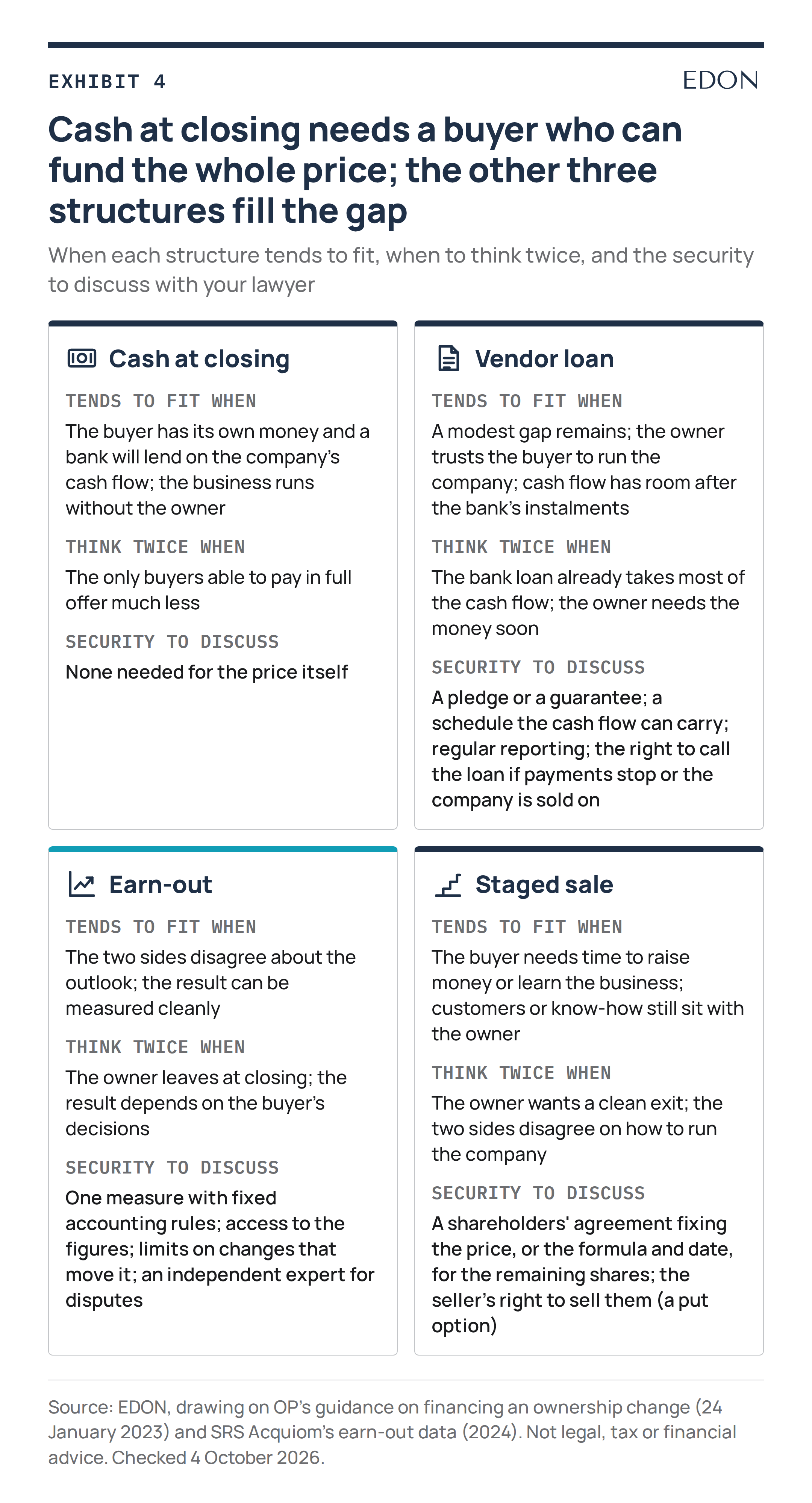
Exhibit 4. Cash at closing needs a buyer who can fund the whole price; the other three structures fill the gap. When cash at closing, a vendor loan, an earn-out and a staged sale each tend to fit, when to think twice, and the security to discuss with your lawyer. Source: EDON, drawing on OP’s guidance on financing an ownership change (24 January 2023) and SRS Acquiom’s earn-out data (2024). Not legal, tax or financial advice. Checked 4 October 2026.
For the part of the price paid later, the seller is a lender and can ask for what a lender asks for. OP names security and covenants as a bank's tools, such as a limit on interest-bearing debt relative to operating profit (EBITDA). Exhibit 4 lists the security to discuss with your lawyer for each structure. Two items matter most. A vendor loan's repayments have to fit the cash flow left after the bank's instalments, and an earn-out's measure and accounting rules belong in the agreement, given how often earn-outs are disputed.
For an owner selling shares as a private person, the Tax Administration's guidance on disposals of securities (opens in a new tab) (in Finnish, 20 December 2022) says a capital gain is income for the tax year in which the binding sale is made, and that the payment date does not, as a starting point, change this. If the company carries confirmed tax losses, a sale of more than half of its shares can forfeit them unless the Tax Administration grants an exception permit (opens in a new tab); EDON's note on the planned 2027 tax changes explains the rule.
Pressing for cash is the wrong move when no buyer can raise the whole price, because an owner who refuses to carry any of it may then wait longer for a sale or accept less. It also backfires when the business still depends on the owner, since a buyer paying everything at closing will price that dependence in. Where a buyer's bank will fund the full price, there is no gap to carry and the owner can take the cash.
Before any price is discussed, it helps to write down three things: the least you need in cash at closing, the most you are prepared to carry and for how long, and the security you would need for it. Then judge each offer by two numbers beside its headline, its value today and the amount still unpaid after closing (Exhibit 3).
EDON is a strategy and transformation firm based in Finland. It works with owners and boards on which parts of a portfolio to grow, fix or exit, and on making the changes work. Your lawyer and tax adviser confirm how the terms and the tax apply to your sale.
If this is on your desk right now, EDON offers a free 30-minute sparring session, with no obligation.
Related

