
Strategy · M&A, Partnerships and Market Entry
If this is on your desk right now, EDON offers a free 30-minute sparring session, with no obligation.
Book 30 minutes (opens in a new tab)
This page is for leaders of medium-sized and large companies, from any country, that are considering Finland: to sell here, to build a presence, to invest or to buy. Our answer: test demand with real buyers first, choose one partner with care, and set up a company only when the commercial case holds.
Some companies arrive with a customer, a tender or a partner already in view; others are still asking whether Finland is worth the effort. Demand is strongest where Finland is investing heavily. Finnish industry counts about 1,500 planned investment projects worth over €336 billion, 60 of the new ones data centres (EK via STT, 2026 (opens in a new tab)), and the government has proposed raising defence spending to at least 3 per cent of GDP by 2029 (Bank of Finland Bulletin, 2025 (opens in a new tab)). Suppliers to the energy transition, data centres and defence have the clearest openings.
Trade with the Middle East still runs mostly one way: in 2025 Finland exported about €400 million of goods each to the UAE and Saudi Arabia, and imported only about €24 million and €22 million from them (Finnish Customs (opens in a new tab)). Capital from the region is already here: ADNOC's XRG holds half of Borouge International, which includes Borealis and its Porvoo site (OMV, 2026 (opens in a new tab)).
The right moment to call is before the first commitment: before you sign a distributor, set up a company or hire your first person in Finland. A tender you are unsure about is another good moment, and so is a first year that brought meetings but no orders.
Kave Asad, EDON's founder, has worked in or with more than 20 countries and has lived in Finland for fifteen years, so we know both sides of an entry: the company arriving, and the Finnish customers, partners and authorities it has to win over.
Finland is more closed than it looks. English is widely spoken and the country is in the EU, yet culturally the market is far more closed than comparable European markets: circles are small and long-standing, and newcomers take time to be let in.
Trust comes before business. Many Finnish firms do not answer unsolicited approaches from abroad (US International Trade Administration, 2025 (opens in a new tab)), and a verbal promise is treated as binding, so promise only what you will deliver (US International Trade Administration, 2025 (opens in a new tab)). Meetings start on time and the talk is plain (InfoFinland, 2025 (opens in a new tab)).
With about 5.66 million people (Statistics Finland, 2026 (opens in a new tab)), the market is small and concentrated: the Helsinki-Uusimaa region holds about a third of them and 39 per cent of GDP (Helsinki-Uusimaa Regional Council, 2026 (opens in a new tab)). In groceries, the S Group and the K Group hold 82.5 per cent of sales (Finnish Grocery Trade Association, 2026 (opens in a new tab)). One distributor usually covers the whole country (US International Trade Administration, 2025 (opens in a new tab)), so the choice of partner weighs more than in a large market.
Public buyers reported €37.6 billion of purchases in 2023 (Ministry of Finance, 2024 (opens in a new tab)), under strict rules. Contracts above €60,000 for goods and services, or €150,000 for works, are announced on the HILMA service, usually in Finnish (Hankinnat.fi, 2025 (opens in a new tab)).
Expect high costs. Prices are more than 20 per cent above the EU average (Eurostat, 2026 (opens in a new tab)). There is no statutory minimum wage, but generally binding collective agreements set minimum pay (Occupational Safety and Health Administration (opens in a new tab)), and employer contributions add roughly a fifth on top of wages (Finnish Centre for Pensions, 2026 (opens in a new tab)). Consumer product instructions must be in Finnish and Swedish (Finnish Competition and Consumer Authority (opens in a new tab)). Invoices, at least, are paid in about 25 days on average (Allianz Trade (opens in a new tab)).
Start light and commit more as you learn. That is the core of the best-known model of how companies go abroad, and its authors later added that the bigger risk is being outside the local network (Johanson and Vahlne, 2009 (opens in a new tab)). The routes, from light to heavy (Exhibit 1):
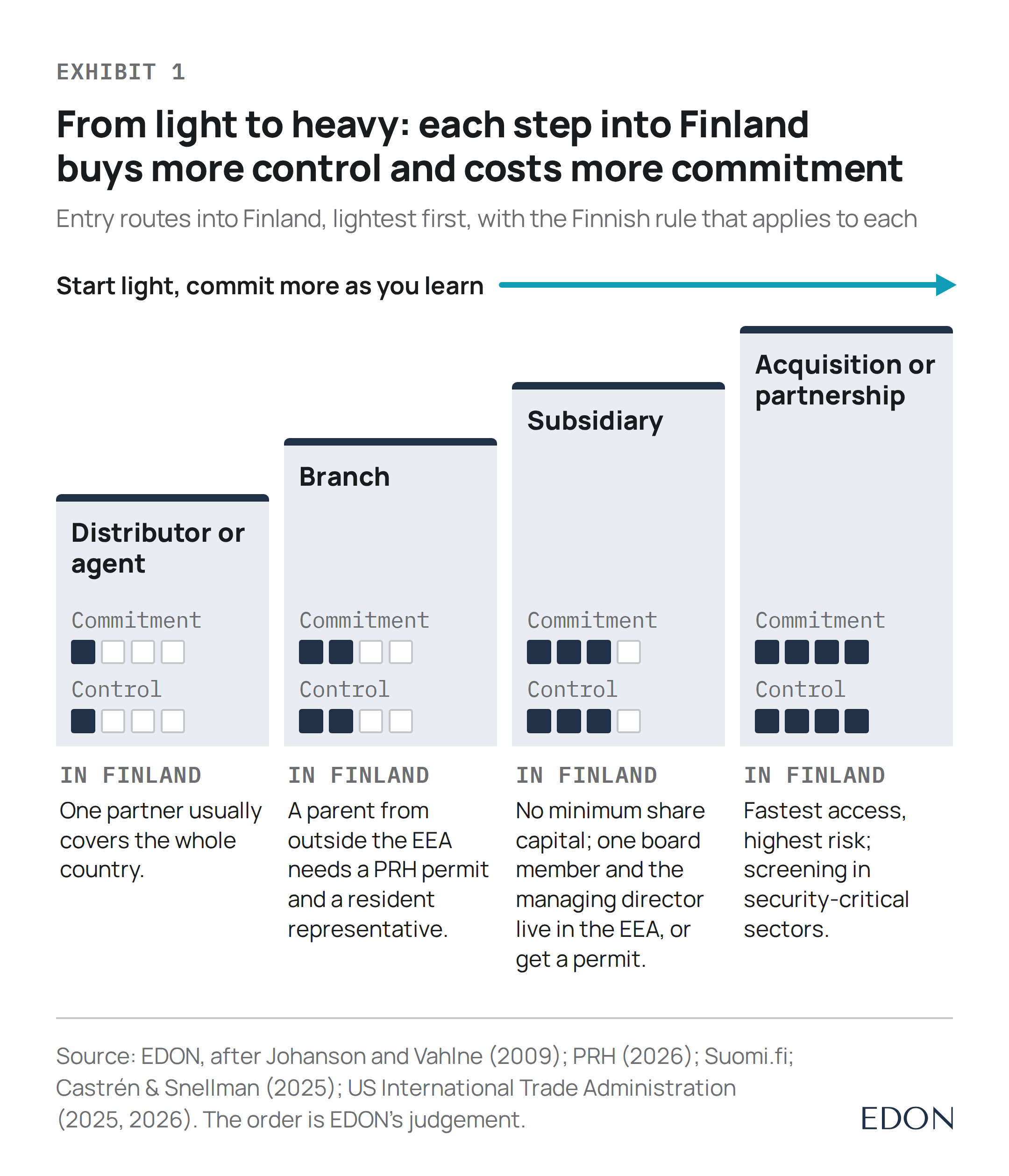
Exhibit 1. From light to heavy: each step into Finland buys more control and costs more commitment.
The first 90 days run in three steps: test demand, find the partner, then set up.
By the end of the first year you want one or two reference customers, a partner or first hire who is delivering, and a clear decision: go deeper, or stay light. Before you sign your first partner, book a free 30-minute sparring session with EDON (opens in a new tab).
Finland ranks second of 182 countries on the 2025 Corruption Perceptions Index (Transparency International, 2026 (opens in a new tab)) and 12th in the world for English skills (EF English Proficiency Index, 2025 (opens in a new tab)). Things work by the book: rules are clear and applied as written, processes run in order, and almost everything, from setting up a company to paying taxes, is done online.
Growth is returning: the Bank of Finland forecasts 1.7 per cent in 2026 and 1.6 per cent in 2027 (Bank of Finland via STT, 2026 (opens in a new tab)). Corporate tax is 20 per cent, and the government has proposed 18 per cent from 2027 (Vero, 2026 (opens in a new tab); see our note on the change). You will not be the first, either: in 2024, 5,685 foreign-owned companies employed 334,330 people in Finland (Statistics Finland, 2025 (opens in a new tab)).
Treaties differ by country. Finland has a tax treaty and an investment protection treaty with the UAE, both from 1996 (Embassy of Finland in Abu Dhabi, 2026 (opens in a new tab)), and an investment treaty with Qatar in force since 2003 (Finlex (opens in a new tab)). There is no tax treaty with Saudi Arabia or Qatar (Finlex, 2026 (opens in a new tab)). Check this before you choose the structure.
A parent outside the European Economic Area faces extra steps: the branch permit, the residence rule for the board and the managing director, and screening in security-critical sectors.
Trust is built differently. In the Middle East it grows mostly through personal relationships (University of Vaasa, 2013 (opens in a new tab)); in Finland, mostly through reliability: keeping time, keeping promises and saying plainly what you can do. Our article on entering Finland or the Middle East goes further.
EDON is a strategy and transformation firm based in Finland, and market entry is part of its M&A, partnerships and market entry work. Early in the work, EDON puts a high-value, usable deliverable in your hands, something you can act on and keep, before you commit further. We call it the Head Start.
Each engagement is scoped around the decisions in front of you: which buyers and partners to test, which route to take, and what you will hold at the end. Scope and deliverables are agreed in writing before the work starts, and we work alongside your lawyers and tax advisers in Finland.
Do we need a Finnish company to sell in Finland? No. Many companies start with a distributor or agent and set up a branch or subsidiary once they need people or contracts in Finland. Plan the first local hire with your tax adviser, because of the taxable-presence rule above.
How long does it take to set up a company in Finland? The start-up notification for a limited company is filed online and costs €400 (PRH (opens in a new tab)); online filings were being processed within a few days in October 2026 (PRH (opens in a new tab)). Check the residence rule for the board and the managing director first.
Can a company from outside the EU bid in Finnish public tenders? It can bid, but it cannot claim equal treatment under EU rules; each buyer decides (Court of Justice of the EU, 2024 (opens in a new tab)).
How do we bring in our first employee from outside the EU? Through a specialist permit. The fast track takes about two weeks, and the salary threshold is €3,937 a month in 2026 (Migri (opens in a new tab); Migri fast track (opens in a new tab)).
If this is on your desk right now, EDON offers a free 30-minute sparring session, with no obligation.
Related

